Energy Transition, Carbon, Emissions
February 27, 2026
ACCU demand seen outpacing supply by 2030, 2026 issuances up to 26 mil: CER

HIGHLIGHTS
ACCU demand to surpass supply later in decade
Combined ACCU, RET schemes cut emissions by 83.7 mil mt in 2025
Australia's carbon market is poised for continued growth in 2026, with Australian Carbon Credit Units issuances projected to reach between 22 million and 26 million units and a potential supply crunch later this decade, according to the Clean Energy Regulator's quarterly Carbon Market Report released Feb. 27.
The CER expects approximately 21 million-22 million ACCUs to be issued from over 600 existing projects that have previously reported, with an additional 1 million-4 million units anticipated from newly registered projects reporting for the first time.
This forecast builds on the record 21.7 million ACCUs issued in 2025 and reflects the market's healthy supply pipeline, "supported by new method development and project registrations."
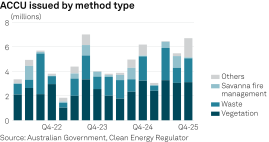
Despite record issuances of 21.7 million ACCUs in 2025, "with the declining baselines under the reformed Safeguard Mechanism, annual demand will grow and may surpass annual supply later this decade," according to the report.
ACCU supply pipeline
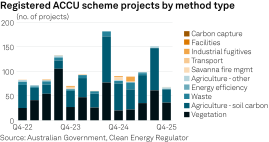
"The ACCU supply pipeline is healthy, supported by the development of new ACCU methods and new and existing project registrations," the regulator noted in its report.
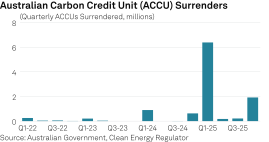
Under the Safeguard Mechanism, covered entities must keep their emissions below baseline levels or offset excess emissions by surrendering ACCUs or Safeguard Mechanism Credits.
Platts, part of S&P Global Energy, assessed SMCs at A$36.05/mtCO2e, down 25 Australian cents/mtCO2e, day over day.
ACCUs are tradable financial products that incentivize carbon abatement activities. They are issued to eligible projects under the country's ACCU Scheme, and participants can earn one ACCU for every metric ton of CO2 equivalent they avoid emitting or storing.
Platts assessed benchmark Generic ACCUs at A$37.30/mtCO2e Feb. 27, down 10 Australian cents/mtCO2e, day over day.
Despite high issuance rates, ACCU holdings continued to grow, reaching 60.7 million at the end of 2025, excluding the cost containment measure, which held 4.8 million ACCUs.
Contract deliveries in 2026
The Australian government announced permanent exit arrangements for fixed delivery carbon abatement contracts in December 2025, offering eligible sellers a 60% discount on exit payment fees if they deliver at least 25% of their outstanding ACCUs as of Jan. 1, 2025.
"Sellers must complete an expression of interest by 30 June, 2026, for the new exit arrangements starting July 1, 2026," the report said.
In 2025, about 900,000 ACCUs were delivered under these contracts, with about 400,000 units delivered after the December announcement. The CER expects contract deliveries to increase in 2026 as participants take advantage of the new arrangements.
Safeguard Mechanism driving emissions reduction
Preliminary data for the safeguard compliance year 2024-25 (April-March) showed a 2.4% reduction in covered emissions, falling from 135.9 million mtCO2e in 2023-24 to 132.7 million mtCO2e in 2024-25.
"Responsible emitters of 59 facilities may be eligible to receive approximately 7 million Safeguard Mechanism credit units," the CER noted, with full results for 2024-25 to be published on April 15, 2026.
The report highlighted that 1.9 million ACCUs were surrendered for safeguard compliance in Q4 2025, with 1.7 million of these surrendered for 2024-25, indicating that some entities are already managing their excess emissions ahead of the March 31 compliance deadline.
The ACCU Scheme and Renewable Energy Target combined reduced emissions by approximately 83.7 million mtCO2e in 2025, comparable to Australia's total emissions from road transport in the same year.
This reduction comprised 21.7 million mtCO2e from the ACCU Scheme, 36.9 million mtCO2e from the Large-scale Renewable Energy Target, and 25.2 million mtCO2e from the Small-scale Renewable Energy Scheme.
"Australia's 2025 emissions would have been almost one-fifth higher without the ACCU and RET schemes," the report said.

Editor: