Fertilizers, Chemicals, Energy Transition, Natural Gas, Renewables, Emissions, Hydrogen
February 19, 2026
Ammonia producers take lead on global blue hydrogen development
HIGHLIGHTS
ExxonMobil, BP suspend major projects
Not all development is fizzling, industry says
The oil and gas industry believed that producing hydrogen and its derivatives could fill new markets for low-emission fuel. But fertilizer companies are competing for the same limited customer base — and so far, with greater success, according to industry watchers.
In 2025, ExxonMobil paused spending on a proposed carbon capture-enabled hydrogen and ammonia plant at its Baytown refinery in Texas. BP canceled blue hydrogen projects in the UK and US, despite receiving government backing from both countries. The year before, Shell scrapped a project in Norway due to a lack of demand, prompting pipeline operator Gassco to cancel a planned link between Norway and Germany.
But not all projects are fizzling.
Fertilizer producer CF Industries Holdings in July 2025 commissioned its first major blue ammonia project, in Louisiana, while securing offtake deals with Japanese companies JERA and Mitsui & Co. for an even larger development.
Another Louisiana project, expected to cost up to $9 billion, was on the brink of cancellation until Air Products & Chemicals enlisted Norwegian fertilizer-maker Yara International as a potential partner. Yara is also poised to start sequestering CO2 from its ammonia plant in the Netherlands.
On a smaller scale, fertilizer producer LSB Industries is nearly finished retrofitting its Arkansas ammonia plant with carbon capture.
As prospective hydrogen developers make capital decisions, there tends to be a distinction between those who see it as "purely part of their business models" and those who see it as "an accessory to all the other things they're doing," said Frank Wolak, president and CEO of the Fuel Cell and Hydrogen Energy Association.
The advantage that CF Industries, Yara and LSB have over their energy industry peers is decades of experience in ammonia production and distribution for nitrogen fertilizer customers. For them, blue ammonia represents not just a new market but a strategy to reduce emissions from their core business.
The European refineries investing in emissions reduction have mostly chosen renewable-powered electrolysis over carbon capture.
"There's probably no direct correlation, other than if you really see value in the hydrogen piece for what you're doing, you're going to sustain the investments," Wolak said in an interview. "If it isn't as important, you'll defer it."
Global development pipeline
Blue hydrogen is produced from natural gas with carbon capture and storage technology. When reacted with atmospheric nitrogen, the result is blue ammonia. Industry watchers use the terms to differentiate blue hydrogen from conventional "gray" hydrogen and ammonia production without CCS, and renewable-powered "green" hydrogen.
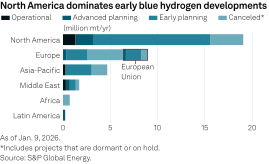
Once confined to a handful of pilot projects, blue hydrogen capacity is growing steadily as early-mover companies bring their first projects online. As of December 2025, global operating capacity had reached 1.7 million metric tons per year, a 24% increase in six months, according to S&P Global Sustainable1. The activity is driven by a combination of US tax credits for carbon capture, Asian import subsidies for clean fuel, European emissions regulations and other climate incentives.
But the development pipeline is shrinking. Almost 6 million mt/y of planned capacity was canceled or suspended in the second half of 2025, far exceeding new project additions, according to Sustainable1.
"The most common reason for project cancellation is failure to secure a long-term offtake contract for a substantial fraction of the plant's capacity," said Brian Murphy, Sustainable1' lead researcher of hydrogen and low-carbon gases in the Americas.
Since demand is mostly dictated by climate subsidies and regulations, policy uncertainty is a contributing factor, Murphy added. Another one is cost inflation.
Some companies have proven better than others at finding customers.
"Companies with an active presence in key offtake markets like nitrogenous chemicals have had more success in securing offtake and reaching [a final investment decision] due to a deep understanding of the dynamics and drivers in those markets," Murphy said.
But industry profile is not necessarily a marker of success, he added.
In 2025, German chemical producer BASF and Yara scrapped a joint venture on the US Gulf Coast. And while other fossil fuel producers are suspending their US projects, Woodside Energy Group is poised to commission a 1.1 million mt/y blue ammonia plant in Beaumont, Texas, in early 2026.
In the EU, the fossil fuel industry is also driving development on the demand side.
"Industrial gas firms are currently retrofitting carbon capture modules on existing steam methane reformers that supply these refineries to reduce carbon price exposure," Murphy said. "However, the structure of carbon trading systems tends to put more cost pressure on fertilizers and chemical products, driving more activity in those sectors."
Regional differences
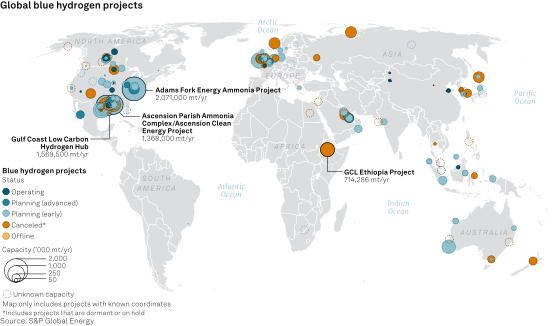
Geography is also a factor. The US Gulf Coast, with its access to low-cost natural gas, has proven a target for development.
In Europe, blue hydrogen projects have largely stalled or been scrapped, hampered by policy headwinds, funding delays and demand uncertainty, with attention focused on renewable production pathways.
Europe has a single CCS-enabled hydrogen plant operating at scale, L'Air Liquide's Port-Jerome facility in France, which uses steam methane reforming with cryogenic CO2 capture technology. The hydrogen supplies North Atlantic France SAS' nearby Port-Jerome-Gravenchon refinery with the purified captured CO2 used for local industrial applications.
Air Products and Air Liquide are both poised to start blue hydrogen production in Rotterdam, Netherlands, with the startup of the Porthos CO2 storage facility in the second half of the year to decarbonize existing hydrogen capacity. Each company expects to produce about 100,000 mt/year and serve customers in the refining and chemicals sectors.
Beyond that, progress has been slow with uncertain regulatory and legislative frameworks holding up investment decisions.
The UK has among the most advanced projects, with Essar Group-owned EET Hydrogen set to make a final investment decision on its CCS-enabled, 78,000-mt/y production facility at the Stanlow refinery in the first half of 2026.
Initially, the hydrogen will serve the refinery's production processes, though EET Hydrogen plans to supply local industry from an expanded second phase via a proposed pipeline.
EU rules governing CCS-enabled hydrogen production came into effect at the end of 2025. However, infrastructure uncertainties and delays have also hindered project development.
Barents Blue, developer of the proposed Barents Clean Ammonia Project in northern Norway, has most recently brought Dutch engineering and project development company Proton Ventures on board, after a series of previous partners pulled out of the 1 million-mt/y facility.
In Asia-Pacific, where most major economies import natural gas, the blue hydrogen production pipeline is modest. Even Australia, an LNG exporter, has instead leaned toward green hydrogen, which the government's climate policies favor.
Meanwhile, Japan and South Korea are opening their markets to blue hydrogen and ammonia for cofiring in thermal power plants before transitioning to pricier renewable-powered fuel. The countries are looking to the US and the Middle East for supply.
"Blue hydrogen is a transition [fuel]. ... The final target is green," Yoshinori Kanehana, director and chairman of the board at Kawasaki Heavy Industries, said at a panel discussion at India Energy Week in Goa in late January.
"If we look all over the world, blue is still relatively cheaper compared to green," Kanehana said. "[As] we need the infrastructure, using blue hydrogen as a transition to establish the infrastructure, then wait till the price of green comes down [is the way ahead]."
Kawasaki Heavy Industries was the first to demonstrate transport of low-carbon hydrogen from the Hydrogen Energy Supply Chain project in Australia, using the ship Suiso Frontier in February 2022. The company plans to begin commercial liquid hydrogen transport by 2030.

Editor: