Energy Transition, LNG, Natural Gas, Emissions, Hydrogen
February 17, 2026
AI accelerates energy project delivery as hydrogen retrofit gains traction

HIGHLIGHTS
AI slashes engineering timelines, boosts project reliability
Hydrogen economy to build on existing gas infrastructure
Digital twins key to repurposing gas infrastructure for hydrogen
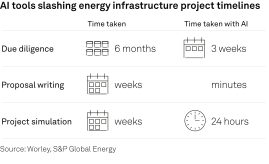
Engineering firms are deploying artificial intelligence tools to accelerate energy infrastructure project delivery, cutting asset due diligence timelines from six months to three weeks, while digital twin technology is emerging as critical for repurposing gas pipelines and terminals for hydrogen transport.
AI is transforming how energy projects are planned and executed, with companies using the technology to compress complex engineering simulations from weeks to 24 hours and streamline supplier selection processes.
Worley Consulting's Global President, Fabricio Sousa, said technology and AI were unlocking the energy transition potential of infrastructure, speeding deployment and enhancing resilience and reliability.
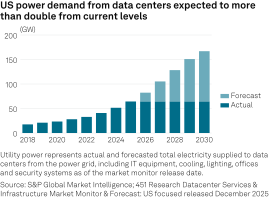
The shift comes as the power sector faces mounting pressure to meet surging electricity demand driven by data centers, AI computing and growing electrification, while advancing energy transition goals.
"It's a sector that always moves at a marathon pace, designing assets that need to last 50 to 100 years," Sousa told Platts, part of S&P Global Energy, in an interview. "Data centers are pushed by a sector that moves at a sprint pace."
Worley has deployed multiple AI tools internally, including consolidating the group's engineering knowledge to accelerate decision-making, and a tool that reduces proposal writing time from weeks to minutes.
The company's vendor selection tool streamlines supplier evaluation across hundreds of potential contractors. Due diligence processes can now be delivered in three weeks instead of six months.
Digital twins
The technology is proving particularly valuable for assessing how existing LNG and gas infrastructure can be repurposed for hydrogen transport, a key consideration as developers seek to build out hydrogen supply chains cost-effectively.
"The hydrogen economy is not going to be built stand-alone," Sousa said. "It is going to be built on repurposed infrastructure by having digital intelligence added to it."
Transmitting energy via repurposed pipelines is two to four times cheaper than creating new overhead power connections, he said.
Digital twins of existing gas assets will enable hydrogen market transformation, mapping systems holistically.
"The digital twin of those assets is going to be to hydrogen exactly what GPS was for logistics," Sousa said.
It would allow engineers to model how pipelines and terminals will perform when handling hydrogen. And Sousa said the model would soon change, with a digital plant preceding the creation of a physical twin, once the system is optimized.
Regulatory challenges
Carlo Luzzatto, CEO of Italian engineering and certification company Rina, said technical challenges around retrofitting infrastructure were manageable.
"When it comes to converting terminal hardware from natural gas to other gases, it has actually been less of an issue than many people initially thought," Luzzatto said in an interview.
But regulatory uncertainty remains a primary barrier to investment decisions.
"What sometimes really holds things back is uncertainty, not so much on the technical side," he said. "There are still technical challenges, of course. It is not as if everything is already solved, but a lot of the uncertainty sits around regulation, safety rules and standards."
Rina is also involved in multiple carbon capture and storage projects, including front-end engineering design work with Malaysia's Petronas, and infrastructure repurposing initiatives in Italy's Ravenna area for CCS.
The conversion of gas pipelines for CO2 or hydrogen transport requires verifying the suitability of materials, welds, coatings and seals, as well as modifications to compression systems. Compressors, for example, need to operate around four times higher to maintain the same pressure for hydrogen because of the molecule size.
For LNG terminals, the flexibility to retrofit infrastructure for changes and to handle different molecules has proven less challenging than anticipated, though it requires investment in cryogenic components capable of handling the different temperatures at which gases liquefy, he said.
"Physics is physics," Luzzatto said. "Different gases liquefy at different temperatures."
Future-proofing assets
The integration of AI into project delivery is not primarily reducing costs on individual projects, but rather improving reliability and accelerating time to first production, Sousa said.
New LNG projects are increasingly being designed as "future-ready" assets, incorporating carbon capture, waste heat recovery and electrification technologies from the outset, he said.
Luzzatto said the energy transition will take longer than previously anticipated, but momentum toward decarbonization and net-zero targets remains intact despite recent setbacks, including the International Maritime Organization's decision in October to delay adoption of its net-zero framework for shipping by one year following pressure from the US.
"The agenda around decarbonization and net zero is already quite far advanced," Luzzatto said. "The target year may change, absolutely, but it is not something that is going to be stopped."

Editor: