Energy Transition, Carbon, Emissions
February 13, 2026
EU carbon prices hit fresh lows as political rift over ETS intensifies
HIGHLIGHTS
EUAs drop below Eur72/mtCO2e
Funds reduce length to 3-month low
EUA-UKA spread widens sharply
European carbon prices fell to their lowest since late July 2025 on Feb. 13 as concerns over competitiveness took center stage for a second consecutive week, with politicians calling for reforms to the EU's Emission Trading System.
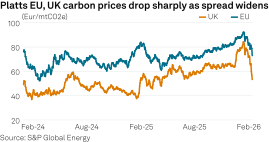
EU Allowances touched Eur71.77/mtCO2e ($85.14/mtCO2e) at 1333 GMT, according to the Intercontinental Exchange, down by more than 8% from Feb. 6. Platts, part of S&P Global Energy, assessed EUAs for the December 2026 contract at Eur72.95/mtCO2e on Feb. 12.
EUAs fell particularly sharply after Germany's Chancellor Friedrich Merz called for the European Commission to revise or postpone the system. Merz later revised his stance in a statement late Feb. 12, referring to the EU ETS as an "effective system and instrument in Europe that allows growth."
"Some colleagues have been very critical of this system [EU ETS]. I don't share their criticism," he said, adding that the scheme has helped reduce emissions within the bloc.
"On the contrary, [emissions] have gone down by almost 40%. And since this system has come, the industry has grown by almost 70%, which indicates that we have the right instrument, but we have to adjust it and adapt it," said Merz.
Merz clarified that the EC would put forward a proposal to help guide potential adjustments to the bloc's carbon market.
Czech, Slovak, and Austrian politicians made similar calls earlier in the week, urging a slower phase-out of free allocations to industry under the EU ETS.
There has been a growing rift between supporters of the bloc's carbon market and countries critical of its impact on industry and competitiveness. EC President Ursula von der Leyen, along with French President Emanuel Macron, has defended the current design of the ETS throughout the week. Von der Leyen said that she would focus on channeling more revenues from member states back to industry during the upcoming ETS review in the third quarter of this year.
Steep drops
Despite no immediate fundamental impact arising from EU politicians, a sharp reduction in investment fund positions also weighed on carbon prices.
"The moves have been amplified by stopping out of positions," Jason Ying, commodities strategist at BNP Paribas told Platts. "Looking back at history, it's not something that can immediately be changed. To change the ETS, to increase supply or adjust allocations, you have to go through a legal process. It could take 12 months to 18 months to get that sorted."
The analyst added that he expects little change to 2026 balances, with any reforms only expected to have a material impact from 2028 onwards.
Investment funds cut long bets by 6.58% as of the week ended Feb. 6, holding a total of 94 million allowances, the least length held since the week ended Oct. 24, 2025, according to a Commitment of Traders report published by ICE.
"COT next week will be very interesting," said a UK-based trader, adding that "this one was just the appetizer, next week's COT will capture the real move."
"Funds have been very, very long, and a lot of them have been washed out now, but fundamental compliance entities don't have the means to sell as much volume," Ying added. "They're inherently long in the market, and they also haven't been buying much either when prices are so high. We think speculation is the largest driver of EUAs over the last six months."
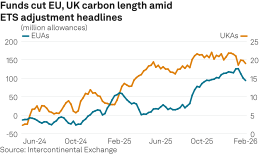
Analysts at S&P Global Sustainable1 said that the reduction amplified volatility in the UK carbon market as funds responded to political signals.
"Previously, heavily crowded speculative long positions helped boost EUA prices earlier this year," said Danylo Babkov, S&P Global Sustainable1 carbon analyst. "However, these positions started unwinding quickly after political comments about possible reform or delay of the EU ETS."
The EUA drop spilled over onto equity markets as well, with utility and cement stocks dropping amid the political headlines. Meanwhile, chemical equities have increased in value due to potential cost reductions if free allocations are extended.
"A lot of this is due to sentiment on decarbonization," added Ying. "For those companies that are harder to abate, such as chemicals, it could be seen as positive for them, as it would reduce costs. It's a view on the potential growth and revenues of these sectors depending on their ability to decarbonize."
UK spread widens
UK carbon prices tracked EUAs lower, dropping to a 10-month low on Feb. 12, while the spread to EU carbon prices held the largest premium over UK counterparts since March 2025.
UK Allowances reached GBP45.65/mtCO2e ($61.97/mtCO2) at 1315 GMT, according to ICE, down by almost 20% from Feb. 6.
Platts assessed the spread between EU and UK allowances at Eur22.01/mtCO2e on Feb. 11, a significant widening from levels of around Eur7-10/mtCO2e earlier this year, when prices were surging across both carbon markets.
The steeper UKA drops come amid political concerns about Prime Minister Keir Starmer as the right-wing Reform UK party, led by Nigel Farage, gains traction in UK polls.
There has also been growing scepticism around the alignment between the UK and EU ETS, with further updates not expected until officials meet in May.
"Since [December], political risks in the UK have started," said Jason Ying. "They've reduced the probability of linkage slightly, as well as weakening the [pound] sterling, and the [foreign exchange] has had a large effect on the spread as well."
Platts assessed UKAs for the December 2026 contract at GBP53.28/mtCO2e on Feb. 12.

Editor: