Electric Power, Energy Transition, Emissions, Renewables
February 13, 2026
Energy transition 'unstoppable' but climate goals out of reach: IE Week panel

HIGHLIGHTS
Solar, batteries driving 'inevitable' shift to clean power
China emissions peak signals shift to electric future
1.5 C rise limit out of reach, may be too late for 2 C
The global energy transition is "completely unstoppable" despite significant political headwinds from the US and elsewhere, though it may be too late to limit global warming to 2 C, leading experts said at the International Energy Week conference in London on Feb. 12.
Energy Transitions Commission chair Adair Turner said the shift to a deeply electrified, zero-carbon future was inevitable due to fundamentally superior technologies.
"We have a set of technologies which are fundamentally superior," Turner said. "The cost of solar is just falling and falling, [...] the cost of batteries is falling."
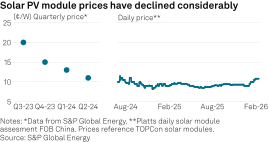
However, the recent silver price spike has nudged panel prices up after steady declines. Platts, part of S&P Global Energy, assessed solar photovoltaic modules FOB China at 10.5 cents/watt on Feb. 12, almost half the price from 2023.
Across the "global sun belt," solar plus batteries would be far cheaper than building new coal- or gas-fired power plants, and would come to be cheaper than running existing fossil-fired generation, Turner said.
"There is no question that the future of the energy sector is broadly electricity with alternative fuels around the edges where you can't electrify," UK Climate Change Committee CEO Emma Pinchbeck said. "That is a future that will happen. When, how fast, in which countries is up for debate, but we shouldn't question the transition, for sure."
The comments came as China's emissions appear to have peaked, with the country's shift toward electrification beginning to reduce emissions for the first time. Turner cited Sinopec's strategic planning to sell zero petrol and diesel through its service station network in China -- currently 40% of the country's retail supply -- by 2049 as evidence of unstoppable trends in road transport electrification.
Power for All founder Kristina Skierka said decentralized renewable energy offered the fastest path to electrification for much of the 600 million people in Africa without electricity access.
"It is much faster to be using decentralized clean forms of energy," Skierka said.
Turner said solar plus batteries was the cheapest form of electricity generation for most of the continent. However, that was not to say African countries should not develop and export fossil fuels to global markets while demand remained.
Climate targets slipping
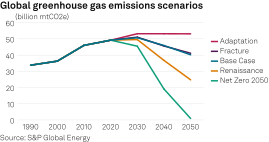
Turner said the 1.5 C warming target under the UN Paris Agreement was already out of reach, with global temperatures already at that level. He said the International Energy Agency's stated policy scenario projects warming of 2.5 C, reflecting the gap between current policies and climate goals.
And Turner said that policies under US President Donald Trump could increase global temperatures by 0.2-0.3 C by 2100.
Skierka said US local government officials are often "first responders to the climate crisis," and continued to drive clean energy adoption, despite pushback from the Trump administration.
US states, counties and cities remain committed to Paris Agreement targets despite federal policy changes, she noted.
But technological change and electrification was not happening fast enough.
"Decarbonization is unstoppable, it's going to be cheaper," Turner said. But he noted China's commitment to reduce emissions by 7%-10% by 2035 and to zero by 2060, was not compatible with limiting global warming to well below 2 C.
"What we have is some unstoppable long-term trends driven by the technology, which left for themselves and even with a determined country like China will occur too slowly to limit global warming to acceptable levels."
Technology costs drive change
Pinchbeck said key indicators for the energy transition remained positive in the UK, particularly after the country's latest renewables allocation round. She also noted growing heat pump sales and electric vehicle adoption.
The CCC is the independent auditor for the UK government's climate targets.
"The indicators still look good," she said.
Pinchbeck acknowledged the current decade presents challenges for the transition, including grid connections, transmission buildout and competition for labor and components. However, she emphasized the fundamental economics favor electrification, noting heat pumps operate 3-4 times more efficiently than gas boilers.
A UK zero-carbon power system would waste approximately half the energy compared to the current system, representing about 500 terawatt-hours of efficiency gains across the economy, according to CCC modeling.
Power grid build-out
Power grids are at the forefront of the electrification drive in the UK.
National Grid Head of Corporate and UK Strategy Abbie Badcock-Broe said in another panel that the artificial intelligence data center boom had taken the company by surprise, but data centers' power consumption could be optimized to help balance the grid.
National Grid was also looking at ramping grid connections to utilize existing capacity, and exploring accelerating connections to distribution networks and using spare capacity from substations, Badcock-Broe said.
"Location becomes increasingly important in a world of scarce grid capacity," Equinor's Head of Policy & Regulation for UK Power, Chris Fox, said.
The company is targeting co-location of renewable generation assets, and is building an integrated power business combining offshore wind, onshore renewables and storage, and flexible generation, Fox said.

Editor: