Fertilizers, Chemicals, Energy Transition, Renewables, Carbon, Emissions
February 13, 2026
Australia’s final carbon leakage review recommends CBAM-like scheme for high-risk sectors
HIGHLIGHTS
Cement, clinker identified as initial priorities for CBAM
Phased approach recommended, aligning with global momentum
Hydrogen, ammonia, steel, iron recommended for second phase
Australia should introduce a border carbon adjustment mechanism for select commodities at high risk of carbon leakage, with cement and clinker as initial priorities, the final Carbon Leakage Review, released Feb. 13, recommended.
The review recommends a targeted approach that would apply carbon tariffs on imports from countries with less stringent climate policies.
"Current Safeguard Mechanism settings are effective at mitigating carbon leakage risk in the short- to medium-term. But settings for some sectors may need to be augmented with additional measures over time," the report said.
The Carbon Leakage Review forms part of the Albanese government's broader Safeguard Mechanism reform agenda, which was legislated in March 2023 and set declining baselines for large industrial facilities to 2030.
The report highlighted the growing concern that, as safeguard baseline decline rates increase, carbon leakage risks will become more significant.
"CMI supports Australia implementing a phased approach to a border carbon adjustment to mitigate the risk of carbon leakage," Director Corporate Transition, Carbon Market Institute, Kurt Winter, said.
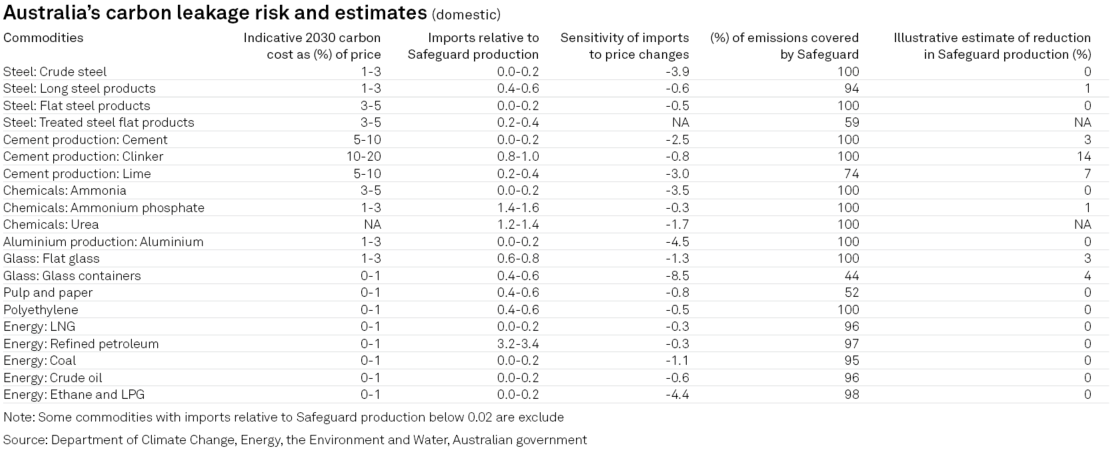
Australia's Safeguard Mechanism covers around 207 of the country's largest industrial facilities.
Under it, the covered facilities are required to keep emissions below their baselines or surrender Australian Carbon Credit Units and Safeguard Mechanism Credits to offset excess emissions.
Platts, part of S&P Global Energy, assessed benchmark Generic ACCUs at A$37.17/mtCO2e ($24.43/mtCO2e) on Feb. 13, up by 32 Australian cents/mtCO2e, while SMCs were assessed at A$37/mtCO2e, up 25 Australian cents/mtCO2e day over day.
The proposed scheme would impose carbon liability on imports from jurisdictions with lower effective carbon prices, mirroring Safeguard Mechanism settings and potentially reinforcing domestic compliance demand as baselines tighten -- a move that could influence ACCU surrenders, industrial abatement costs, and trade flows in key sectors.
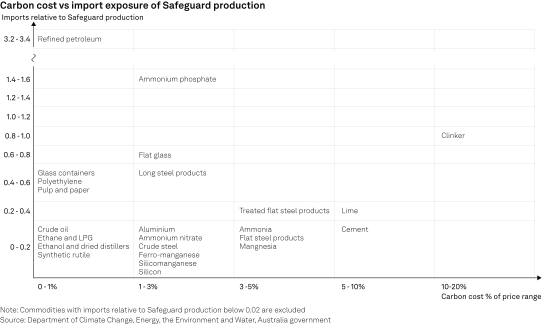
The review identified clinker as most exposed to carbon leakage risk (a potential of about 14% import increase by 2030 under a maximum scenario), followed by lime (about 13.5% combined import/export impact) and cement (about 2.5% rise in imports).
"Should a border carbon adjustment be pursued, a border carbon liability could be applied to emissions in exceedance of the SM baselines," the report said.
Phased implementation
A second tier of commodities -- lime, hydrogen, ammonia and derivatives, steel and iron, and glass -- was identified as candidates for the next phase.
For steel specifically, the review noted that while a border carbon adjustment could help address leakage risks, implementation would need to be approached cautiously.
BlueScope, a leading steel supplier and manufacturer, based in Melbourne, noted in its submission to the November 2023 consultation that the risk of doing irreversible damage is very high -- a poorly designed CBAM would make iron and steelmaking in Australia unviable.
The review suggests piloting the scheme on specific steel products with suitable characteristics before expanding to the broader steel and iron group.
The review explicitly rejected implementing carbon rebates for exports, noting such measures would be "inconsistent with Australia's emissions reduction targets."
Impact on cement, clinker
Australia relies on imports to supplement domestic cement supply, with Japan, Indonesia, and Thailand among its main sources of clinker and cement, according to market participants across Asia.
Indonesian producers that Platts spoke to did not signal any major reaction or immediate plans to implement carbon border measures, but an Indonesia-based source said that such a scheme is unlikely to affect trade flows in the near term.
Vietnamese producers also said that the current CBAM policy, particularly in Europe, has had little impact on their exports to Asia-Pacific markets so far.
"CBAM is primarily a European issue at this stage. For regional shipments, including to Australia, we haven't seen any direct effect yet," a Vietnam-based producer said.
Platts assessed cement (ASTM type I) FOB Vietnam at $38/mt on Feb. 12, stable week over week, while cement clinker FOB Vietnam was at $34/mt on Feb. 12, up from $33.5/mt FOB the previous week.
International alignment
The recommendations align with growing international momentum toward border carbon adjustments, with the EU implementing its Carbon Border Adjustment Mechanism in October 2023 (with full enforcement beginning in 2026), and the UK, Canada, and the US all exploring similar measures.
The EU now requires importers of carbon-intensive goods from six covered sectors -- aluminum, cement, electricity, fertilizers, iron and steel, and hydrogen.
EU carbon prices touched four-month lows, Feb. 6, as free allocation headlines deflated bullish expectations, Platts reported earlier. The Platts-assessed EU Emission Allowances for the nearest December have continued to fall since then and were assessed at Eur72.95/mtCO2e Feb. 12.
The report emphasizes Australia's opportunity to create a level playing field for traded heavy industry commodities and to help create the building blocks of an internationally interoperable system.
The government will consider the recommendations as part of the 2026-27 review of the Safeguard Mechanism, suggesting implementation would not occur before that timeframe.

Editor: