Electric Power, Energy Transition, Renewables
February 10, 2026
California RECs face headwinds in January, as new bill may drive prices

HIGHLIGHTS
California RECs face price pressure amid thin liquidity
Bill aims to lower electricity costs
California US renewable energy certificate prices remained under pressure through January 2026, pointing to thin liquidity and limited bid depth across Portfolio Content Categories 1 to 3, also referred to as "buckets." Meanwhile, policymakers are pushing Senate Bill 868 to soften electricity costs, which could drive REC prices by the summer.
California RECs extended the downward price trend seen across 2025, as values entered 2026 with far less momentum than anticipated, due to illiquidity and decreased activity, with no additional demand to meet sustainability targets at the beginning of the year.
Platts, part of S&P Global Energy, last assessed PCC3 2025 at $3.20/MWh and PCC3 2026 at $4.05/MWh on Feb. 5, while PCC1 2026 and PCC1 2027 closed at $10.95/MWh and $16/MWh, respectively, on the same date. Meanwhile, PCC2 2026 was assessed at $11.95/MWh and PCC2 2027 at $12.20/MWh.
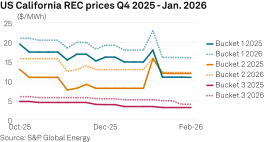
The muted tone on the market is primarily due to seasonality and thin buying interest.
"[The decline in prices was] largely a calendar effect," a trader said. "A scarcity of bids left offers dominating screens," they added, suggesting oversupply was pressuring prices.
However, the price downtrend could see a different path amid legislative changes. The SB 868 bill, known as "The Plug and Play Solar Act," aims to expand access to behind‑the‑meter clean energy, particularly for renters and residents of multifamily buildings who typically lack rooftop solar access, and its acceptance could make California the second state to allow plug-in solar systems.
"Californians should have every tool available to lower energy costs," Senator Scott Wiener said in a Jan. 6 statement, adding that renters and apartment residents "deserve options to lower costs and access clean energy."
If adopted at scale, SB 868 could become part of the REC narrative in the summer of 2026, not necessarily as an immediate driver of compliance REC demand, but by showing that lawmakers are tying affordability and clean‑energy goals together.
Market imbalance and uneven liquidity across the buckets
Beyond seasonality, persistent market imbalances and uneven liquidity were reported over PCC1, PCC2 and PCC3 across all vintages. Although California RECs were expected to see more activity from mid-January onward, trading was largely quiet.
"[California] has been quiet as of late," a trader said, with PCC1 2026 described as "all over the place" due to a wide bid-offer range. The trader also added: "[Liquidity was] difficult to confirm," with sellers struggling to move volumes in the absence of active buyers.
A US REC broker told Platts: "A number of people had reached out about [US] RECs recently", which "sounds like there might be a bit of oversupply they are trying to move," but the inexistence of bids made the sale impossible.
This points to a market described by oversupply and imbalance between buyers and sellers. Taken together, conversations across January 2026 suggest persistent offer pressure and thin bidding activity have kept the market tone soft, particularly for PCC3 contracts.

Editor: