Fertilizers, Chemicals, Energy Transition, Renewables, Carbon, Emissions
February 10, 2026
Ammonia traders grapple with CBAM fallout as EU imports plunge
HIGHLIGHTS
January imports slip almost 50% year over year
Importers face higher costs from default CO2 values
Possible fertilizer exemption worries traders
Uncertainty over the EU's Carbon Border Adjustment Mechanism has caused concerns in European ammonia markets, slashing imports to the bloc in January, and leaving traders unsure about how the tax mechanism will apply to the sector, market participants said.
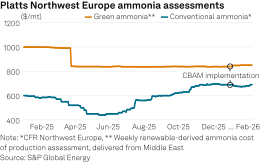
January ammonia imports to the EU stood at 130,000 metric tons, falling by almost half from December, data from Platts, part of S&P Global Energy, showed. Traders had stocked up in December ahead of the start of CBAM, but imports were also down 46% on the year in January, the data showed.
Traders are trying to navigate uncertainty over whether and when CBAM will apply to ammonia and fertilizers, after EU Commissioner Maros Sefcovic said in January the European Commission could use an "emergency brake" to exempt the sector from the tax.
Sefcovic suggested the Article 27a mechanism that addresses "serious and unforeseen circumstances" that could affect the price of goods could be applied retroactively from Jan. 1 to support the agricultural sector.
CFR Northwest Europe ammonia prices averaged $679/mt in January, according to Platts assessments, compared with $592/mt in January 2025.
However, there is no guarantee that the EC will pull the emergency brake.
This leaves traders unsure how to value low-carbon ammonia imports, and uncertain about whether they can pass on costs to customers, trade sources said.
Carbon intensity calculations
Under CBAM, importers of carbon-intensive goods into the EU from six covered sectors -- aluminum, cement, electricity, fertilizers, iron and steel, and hydrogen -- must account for the embedded carbon content of their products from Jan. 1.
Importers do not have to purchase CBAM certificates until 2027, giving businesses time to adapt.
But arguably, more of an issue for ammonia importers was the last-minute delivery of key information about the flagship carbon tax mechanism.
The EC provided key details -- including carbon intensity default values, CBAM benchmarks, and emission calculation methodologies -- only in mid-December, just days before the policy took effect.
The EC is working on an action plan for fertilizers to be presented in the first half of 2026, Agriculture and Food Commissioner Christophe Hansen said at a Jan. 26 meeting of the Commission's Agriculture and Fisheries Council.
Cost impact
In the meantime, the market is navigating increased costs for imports.
Under CBAM, goods imported into the bloc are subject to a default value for embedded emissions if there is no carbon intensity certification. US ammonia has the highest default value among the main suppliers to the EU, potentially raising costs for buyers.
Based on carbon prices in December 2025, this will mean at least an additional $35/mt cost for importers, for even the very cleanest of options.
The average carbon intensity factor of imports is 2.2 metric tons of CO2 equivalent, while the default value for products from the US is 3.4 mtCO2e, according to EC documentation and sources.
And while European producers have their emissions certified and audited, certification for the carbon intensity of overseas projects has not been finalized, leaving producers and importers dependent on default values, ammonia importing sources said.
"US ammonia has become significantly less attractive," a European importer told Platts. "The exposure is significant."
The importer said volumes from Algeria were a "good option" as default and actual carbon intensities were more closely aligned.
"A windmill from the US that makes green ammonia is 3.4 [mtCO2e], unfortunately," the importer said.
The importer added carbon intensity verification for overseas projects might not happen before 2027 or 2028.
The EC did not respond to a request for comment by Platts.

Editor: