Fertilizers, Chemicals, Energy Transition, Electric Power, Renewables, Hydrogen, Nuclear
January 21, 2026
IEW 2026: India to deliberate on next steps for energy transition after landmark year for clean energy

HIGHLIGHTS
Talks likely on localization, creating domestic demand
Policymakers, CEOs, tech heads to attend key event
Energy transition focus shifts to nuclear, batteries
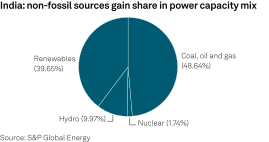
India is set to deliberate on the next steps for its energy transition after a pivotal year in which it tendered major renewable hydrogen/ammonia projects and added its highest-ever renewables capacity, pushing non-fossil fuels to over 50% of its installed power mix.
At India Energy Week 2026 to be held in Goa over Jan. 27-30, policymakers will share the stage with company heads and technology providers to outline India's priorities, offering a clearer view of how the country plans to accelerate clean fuel deployment.
"India Energy Week must deliberate on the kinds of new and clean energy sources to prioritize, which specific areas to target, and the right technology mix," Rajnath Ram, advisor -- energy at policy planning body Niti Aayog told Platts, part of S&P Global Energy.
The event will also emphasize localizing clean-tech manufacturing, because India "needs to have a domestic supply chain, because our energy demand is very high."
Although India's net-zero target is set for 2070, its near-term targets, including 500 GW non-fossil fuel-based power capacity by 2030 from around 263 GW now, and 5 million mt of renewable hydrogen production in the same year, are very ambitious.
Record-making year
To push the targets, the government conducted an aggregated demand auction for 13 fertilizer firms to buy 724,000 mt/year of domestically produced renewable ammonia, and renewable methanol tenders are to follow.
Meanwhile, refiners Indian Oil, Hindustan Petroleum, and Bharat Petroleum awarded contracts to build captive renewable hydrogen plants, and other oil and gas firms have also indicated similar plans.
"This is a year of execution and global partnerships for energy transition for hydrogen," Harish Jayaram, vice president -- business development at renewable hydrogen/ammonia developer Hygenco Green Energies, told Platts.
"There'll be a lot of focus on building capabilities within the country, in manufacturing, and also development of technology locally, given that we're seeing tremendous protectionism globally."
While the clean fuel tenders were a kind of first in Asia, the country accelerated renewable power capacity expansion, marking the highest additions of 44.5 GW in 2025 [till November], with the momentum seen continuing.
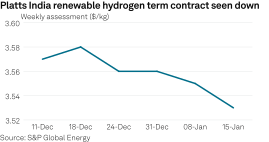
Platts assessed the India renewable hydrogen term contract at $3.53/kg on Jan. 15, down 1.1% from Dec. 11, when the assessment was launched.
India, China – the outliers
IEW 2026 is to be held amid escalating geopolitical tensions that have disrupted supply chains and driven up commodity prices, hurting the clean energy sector.
However, a clear strategic shift is emerging in two of Asia's largest economies -- India and China -- as they refocus on stimulating domestic demand for clean energy amid a weakening export outlook, experts added.
"Unlike the path we had envisaged at the time of releasing the National Hydrogen Mission, I am now of the view that domestic consumption should lead exports," Bhupinder Singh Bhalla, chair of the governance board at trade body GH2 India and former secretary in the Ministry of New and Renewable Energy, told Platts.
"If the domestic green hydrogen ecosystem is allowed to flourish and costs fall, you can produce green ammonia, green methanol, or any derivative at the lowest possible price. That, in turn, helps you break into export markets."
China's recent cancellation of export tax rebates on methanol and photovoltaic products may help firm up prices and strengthen internal markets and value chains for low-carbon fuels, thereby supporting the country's energy transition goals, S&P Global Energy analysts said.
The strong domestic support has even helped these Asian nations to sign large binding supply deals for renewable ammonia as evident from the AM Green-Uniper deal in India and the Envision-Marubeni deal in China.
Veering towards nuclear, batteries
At a past IEW, a prominent Indian government official remarked that the country's energy transition is akin to "building the plane while flying it," suggesting that the government's approach must remain flexible and dynamic.
True to that sentiment, India's energy transition is now witnessing new horizons open up.
Niti Aayog's Ram said nuclear energy and batteries were new avenues for India's energy transition, now seen as crucial pieces of the jigsaw puzzle that will ultimately determine the country's ability to build a resilient, low-carbon economy.
"Opening of the nuclear sector is crucial -- if you are reducing your fossil consumption, particularly in the power sector, you need a constant baseload power," Ram said, referring to the nuclear energy policy announced in the budget of 2025-26 with a target of 100 GW by 2047.
Another critical aspect, Ram added, is the need to create stronger incentives for storage projects -- namely pumped hydro and BESS -- both essential for managing intermittency and thus strengthening renewables.
"If we get these two, we'll be done."

Editor: