Electric Power, Metals & Mining
April 24, 2026
INTERVIEW: Europe’s battery boom faces hurdles despite Middle East war clean energy boost

Editor:
HIGHLIGHTS
Grid delays threaten BESS growth: Fieldfisher
Germany faces acute grid saturation issues
Europe's BESS capacity to hit 100 GW by 2030
The conflict in the Middle East is expected to accelerate demand for clean energy in Europe and boost the case for battery storage, while straining supply chains and intensifying pressure on grid connections and permitting, experts at European law firm Fieldfisher told Platts in an interview April 22.
Europe's large-scale battery storage capacity is set to increase sixfold to over 100 GW by 2030, but the growth story faces regulatory obstacles with progress depending on grid upgrades, simplified planning processes and reliable legal frameworks for investors and developers, the firm said in a recent report.
"After 18 months of unprecedented expansion, Europe's battery energy storage sector is increasingly facing regulatory and grid access barriers. Investors want to support Europe's storage build-out, but they need certainty," said Daniel Marhewka, co-head of Fieldfisher's energy, natural resources and sustainability group.
"100 GW of battery capacity is ambitious, but doable," Marhewka said.
Fieldfisher's analysis spans 11 European markets, supported by its BESS Market Maturity Index, which assesses countries across five legal and regulatory pillars: regulation, grid connection, investor confidence, incentives and cybersecurity.
Most markets already face saturated grids, resulting in long waits for connection approvals and increased uncertainty about project viability.
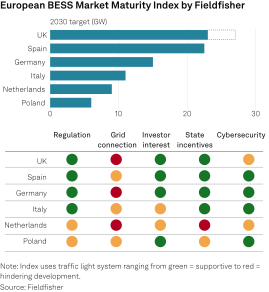
Germany's situation is the most acute, according to Fieldfisher.
Transmission grid operators received 226 GW of new grid connection requests from battery developers in 2025, far exceeding available capacity, with one grid operator confirming no further capacity until 2029, Marhewka said.
Despite this, Germany has emerged as the EU's leading market for battery energy storage systems, with Eur8 billion ($9.35 billion) in completed deals across 160 projects, demonstrating substantial institutional commitment, according to Fieldfisher.
"The market is also seeing regulatory changes and competitive dynamics that mirror the UK's evolution toward market saturation," Marhewka said, noting that the 2029 grid fee waiver expiration represents one of the sector's most significant catalysts and constraints.
Regulator BNetzA is currently reviewing grid fee rules for battery projects. The industry is calling for an extension of the grid fee waiver until 2034, Marhewka said.
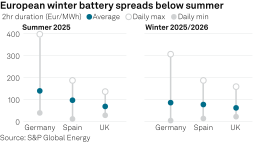
Platts, part of S&P Global Energy, assessed the battery spread for a two-hour battery in the day-ahead market at an average Eur112.99/MWh over the past year.
Daily spreads rebounded this spring, with the average winter spread some Eur53/MWh below the summer spread, analysis of Platts pricing data shows.
UK ambition meets new obligations
The UK remains the European market leader, aiming for 23-27 GW of battery storage by 2030, up from about 7 GW.
Regulatory reform is reshaping the UK market, with the shift to "first ready, first connected" grid rules, giving legally prepared projects a clear advantage, accelerating connection timelines by up to two years, according to Fieldfisher.
"Economics always plays the key role; projects do not happen without investors," said Anna Crosby, partner at Fieldfisher, noting that the forthcoming Cybersecurity and Resilience Bill will classify BESS as critical national infrastructure, introducing tougher reporting obligations and independent vulnerability audits.
"Combined with stricter fire safety requirements under the BESS Fire Safety Bill, the UK now presents both high potential and significant compliance demands," Crosby said.
UK battery spreads averaged about Eur66/MWh over the past year, with the market less impacted by solar, compared with Eur87.31/MWh in Spain, Platts data show.
"From a revenue perspective, it is crucial to determine whether project finance structures will be required. If so, mechanisms such as revenue floors, tolling arrangements or long-term capacity contracts may be necessary. If not, revenue opportunities may instead be optimized through more flexible market-based commercial arrangements," said Feilim O'Caoimh, co-head of Fieldfisher's energy unit.
Solar curtailment boost for BESS
Despite barriers, Europe offers opportunity. Especially co-locating batteries with solar or wind can increase revenues by up to 25%, Fieldfisher said.
Many of these opportunities, however, depend on proactive regulatory positioning, early legal risk mitigation and securing grid access ahead of tightening queues.
"The legal framework providing transparency for, and supporting, the commercial case is now essential to getting projects over the line," Marhewka said. "Europe's battery storage ambition is real -- but to make it come true, investors and financiers must navigate the ever-changing regulatory framework."
Analysts at S&P Global Energy CERA forecast European front-of-meter battery storage capacity at about 120 GW in 2030.
The battery boom has already helped double lithium prices from record lows last summer.
Platts assessed battery-grade lithium carbonate CIF Europe at $20,500/mt on April 22, the highest since June 2024.
