Electric Power, Energy Transition, Renewables
April 09, 2026
Washington declares statewide drought emergency, snowpack half of normal

By Kassia Micek
Editor:
HIGHLIGHTS
Fourth statewide drought emergency since 2015
Mid-C spot prices jump $4.50 day over day
Washington has declared a statewide drought emergency, driving up wholesale spot power prices, after starting April with roughly half of its normal snowpack.
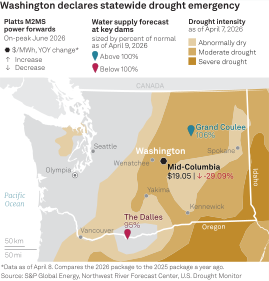
A warm winter left Washington mountains bare, leading to projections that water supplies will fall short of the state's summer demand, the Washington Department of Ecology announced April 8. This is the fourth statewide drought emergency since 2015.
"One year ago, we announced an unprecedented third year of drought, primarily affecting the Yakima Basin as well as other parts of the state," Casey Sixkiller, director of the Department of Ecology, said at an April 8 briefing. "Today, we are gathered again, but to declare a drought emergency for the fourth year in a row and this time it's statewide."
Market reaction
Pacific Northwest spot power prices increased during April 9 trading, while other US West locations eased. Mid-C on-peak day-ahead traded around $18/megawatt-hour for April 10-11 delivery on the Intercontinental Exchange, an increase of nearly $4.50 from where Platts assessed the location a day earlier. The off-peak package climbed nearly $6.50 day over day to trade around $21.25/MWh on ICE. Platts is part of S&P Global Energy.
"The Pacific Northwest in the US experienced a warmer-than-average winter this year, with a greater share of precipitation falling as rain rather than snow," said Hilary Bao, S&P Global Energy CERA senior analyst.
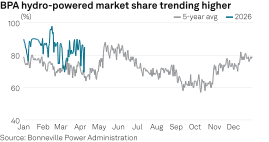
From December 2025 to March 2026, hydropower generation was approximately 15% above the 30-year average, she said.
"However, due to poor snowpack accumulation, hydropower generation is expected to decline significantly in May, June and July," Bao said. "S&P Global Energy forecasts that hydropower output will be about 12% below the 30-year average for each of these months."
CERA forecast Mid-C spot power prices to average in the mid-$60s/MWh in August. In 2025, Mid-C spot prices reached as high as $112.20/MWh on Aug. 25, and averaged nearly $50/MWh for August and $56/MWh for September, according to Platts data.
The long-term weather forecast predicts above-normal temperatures and below-normal precipitation through June, according to the Department of Ecology.
Drought emergency
Drought is declared when water supply drops below 70% of normal and creates hardships for people, farms or the environment, Sixkiller said about state law.
"This year, every watershed in our state has met that threshold," Sixkiller said. "We have entered April with roughly half of our normal snowpack."
April 1 is typically when snowpack peaks, but "this year, we are at just 52% of normal and that gap has real consequences," Sixkiller said.
Although the state had a wet winter with 104% of normal precipitation from October to February, too much of that fell in the form of rain instead of snow, the Department of Ecology said.
"Washington relies on deep mountain snows to accumulate over the winter, then gradually melt during spring and summer," according to the Department of Ecology. "That slow snowmelt helps fill streams and rivers and replenish reservoirs. Without sufficient snowpack, rivers will run low and water temperatures will climb, creating harsh conditions for fish and other aquatic species."
The Dalles forecast
The Dalles Dam water supply forecast is currently at 95% of normal for the April-September forecast period, a decrease of 2 percentage points month over month, according to Northwest River Forecast Center data. The water year runs Oct. 1 through Sept. 30.
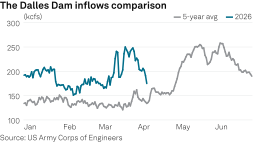
Conditions at The Dalles Dam, located on the Columbia River on the Oregon-Washington state border, serve as the barometer for hydro conditions in the region. Lower hydro generation in the Pacific Northwest means less generation available for export to neighboring regions. However, the trend has reversed in recent years, with the Pacific Northwest importing power generation due to a weaker hydro supply from ongoing drought, rather than exporting generation during hydro surplus.
