Electric Power, Energy Transition, LNG, Natural Gas, Renewables, Nuclear
April 07, 2026
US EIA trims 2026 US spot gas price forecasts on near-average storage expectation
By Ronnie Turner and Maya Weber
Editor:
HIGHLIGHTS
Expects LNG exports to rise to record 17 Bcf/d in 2026
Summer power demand set to increase 2.3% from 2025
The US Energy Information Administration on April 7 again trimmed its natural gas spot price forecast for the second and third quarters of 2026, saying that it expects Henry Hub prices to remain closely aligned to the year-ago quarters, with inventories remaining near average.
The agency, in its April Short-Term Energy Outlook, forecast that Q2 Henry Hub spot gas prices will average $3.01/million British thermal unit, 9 cents below the March estimate. The Q3 forecast was lowered by 7 cents from the March estimate to $3.26/MMBtu.
The April STEO marked the second consecutive month in which the agency lowered its spot gas prices for the rest of the year.
The EIA now expects Henry Hub prices to average $3.67/MMBtu for 2026, 9 cents below the March full-year forecast. The agency also lowered its 2027 Henry Hub price forecast by 26 cents from the March estimate to $3.59/MMBtu.
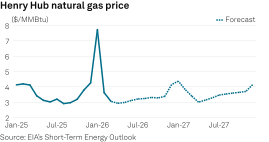
The agency estimates that gas inventories finished the 2025-26 withdrawal season, which ended in March, at about 1.9 trillion cubic feet, or 3% above the five-year average (2021-2025). Storage levels rebounded after large withdrawals in January as a result of rising production and relatively mild weather for the rest of the winter season, the EIA said.
"With inventories near average, we expect Henry Hub prices in 2Q26 and 3Q26 to remain close to recent seasonal norms, averaging about $3.10/MMBtu, closely aligned with the same quarters last year," the agency added.
Gas production, LNG exports
The EIA's forecast for US-marketed gas production in Q2 was left unchanged from the March estimate of 120.3 billion cubic feet/day, but the agency raised the forecast for Q3 by 400 million cubic feet/day to 120.7 Bcf/d. The full-year forecast was increased by 100 MMcf/d to 120.7 Bcf/d.
Looking further ahead, the agency raised its forecast for US-marketed gas production in 2027 to 124.2 Bcf/d, 300 MMcf/d above the March estimate.
The near-term increases in gas production are expected to help bolster storage levels, the agency said.
"We forecast more natural gas will be injected into storage than is typical this year, largely because increased crude oil production supports more associated natural gas production," the EIA said. "We expect marketed natural gas production to increase 2% in 2026 and 3% in 2027. This outlook depends on how production growth materializes, how much natural gas the electric power sector consumes this summer, as well as the pace of LNG export ramp-up."
The EIA lowered its gas consumption estimates by 300 MMcf/d to 77 Bcf/d for Q2 and by 500 MMcf/d to 84.9 Bcf/d for Q3. The full-year 2026 estimate was lowered by 800 MMcf/d to 90.6 Bcf/d.
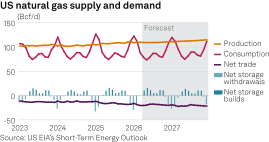
The EIA also anticipates an increase in LNG exports in 2026. The agency forecasts that full-year 2026 LNG exports will total 17 Bcf/d, up 300 MMcf/d from the previous month's estimate, and that 2027 LNG exports will total 18.6 Bcf/d, up 500 MMcf/d from the prior forecast.
Both numbers would surpass the annual record of 15.1 Bcf/d in 2025, the agency said.
"We estimate U.S. LNG exports were 17.9 Bcf/d in March, an 8% increase over our January STEO forecast and the second-highest LNG export volume on record following December 2025," the EIA said. "The widening spread between domestic and international prices as a result of continued disruptions to LNG exports through the Strait of Hormuz encourages increased LNG exports from the United States, although capacity is constrained."
Electricity demand, generation
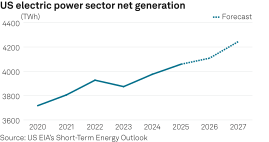
The EIA updated its US electricity demand forecast to show an expected 1.2% increase to 4,108 billion kilowatt-hours in 2026. The 2027 power demand forecast is for 3.3% growth to 4,244 billion kWh.
The agency expects total demand for the 2026 summer season, spanning June through September, to increase by 2.3% from the same period in 2025, and 2027 summer demand is expected to rise by 3.7% compared to the 2025 period.
"We expect residential demand to grow by 2.9% in the summer of 2026 and by 1.0% in 2027," the EIA said. "Summer power demand from the commercial sector grows by 2.6% in 2026 and by 5.8% in 2027, and summer power demand from the industrial sector grows by 0.9% in 2026 and 5.1% in 2027."
The EIA expects total US electricity generation to increase by 1.2% to 4,325 billion kWh in 2026 and by 3.4% to 4,470 billion kWh in 2027. The bulk of generation growth in 2026 is expected to come from renewable sources, including solar (17% growth), hydropower (6%) and wind (5%), the EIA said.
Over this summer, the EIA expects solar power resources to produce 17% more power than they did in the summer of 2025.
"In 2025, solar generation in the summer months surpassed wind generation for the first time, and that trend continues in our forecast," the agency said. "In the summer of 2027, we expect solar generation will grow by 22% to reach 178 billion kWh, surpassing wind generation by almost 30%, although we still expect wind will generate more electricity than solar for the whole year."
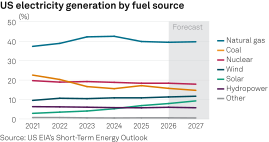
The EIA forecast gas-fired generation during the 2026 summer months will remain flat compared with last year, and nuclear generation is expected to grow by 2% as a result of the planned restart of the Palisades plant in Michigan.
