Fertilizers, Chemicals, Energy Transition, Agriculture, Refined Products, LNG, Natural Gas, Renewables, Emissions, Hydrogen, Biofuels, Jet Fuel, Carbon
March 27, 2026
CERAWEEK: In the case for clean resources, 'energy security' tops 'energy transition'

By Siri Hedreen
Editor:
HIGHLIGHTS
Europe may boost domestic hydrogen production
Middle East conflict threatens ammonia supply
Clean hydrogen and ammonia backers are making the case that alternative fuels can lower nations' reliance on imports of fuel from the Middle East, as public and private climate goals fall by the wayside.
Green and blue hydrogen are still touted as lower-emission substitutes to conventional "gray" hydrogen -- used in fertilizer production and refining -- and fossil fuels. But the corporate climate case has largely been supplanted by the case for diversification, industry participants said at the CERAWeek by S&P Global Energy conference in Houston.
"Four or five years ago, it was a climate-driven conversation," Rik Sneep, senior vice president at Spain-headquartered integrated energy and chemicals company MOEVE, said during a March 25 panel. "I think it's now more of a security-driven conversation. But in the end, the target is the same."
The war with Iran has added to the sense of urgency.
"It's terrible what's going on in the world right now," Woodside Energy Group Vice President Rick Beuttel, head of the Australia-headquartered oil and natural gas producer's New Energy division, said on the sidelines of CERAWeek. "But it's a good time to bring in a new ammonia plant where the ammonia can get to market without having to pass through the Strait of Hormuz."
Europe
If the conflict continues, industry watchers see several potential outcomes for clean fuels. The first is an uptick in demand for domestically produced renewable-powered fuels and biofuels, despite their green premium.
In the EU, some hydrogen end-users were already switching from gray to green to comply with the trade bloc's emission caps. The EU's new carbon tax on foreign imports, known as the Carbon Border Adjustment Mechanism, has also encouraged some domestic and international producers to reduce their emissions. But the clean hydrogen market is still smaller than many had forecast due to regulatory delays and weak voluntary demand.
A prolonged fossil fuel shortage could expand that market, industry watchers said.
"A concrete example of this is [the] production of sustainable aviation fuel, not for the compliance market anymore, but also for the defense sector," Yassir Ghiyati, chief commercial officer for equipment manufacturer Topsoe, said.
Renewable power is also more stable in price than fossil fuel feedstocks, added Michele Azalbert, chief hydrogen officer at PETRONAS subsidiary Gentari. Furthermore, Azalbert said, producing green fuels domestically may be seen as a hedge against logistics costs, which spiked in Europe during the coronavirus pandemic and the Russian invasion of Ukraine.
"I think Europe has still to realize what is going to hit," Sneep said.
Before the Iran conflict, Europe imported 20%-25% of its refined products through the Strait of Hormuz, whereas Asia imported 70%-80%, Sneep said. As a result, European energy consumers may be temporarily insulated from the strait's closure, he added.
North America
Customers in the EU and Japan -- another early adopter -- could also become more dependent on North America over the Middle East for low-emission hydrogen and its derivatives. While the US green ammonia pipeline is negligible, fertilizer producer CF Industries Holdings recently began shipping blue ammonia from its Louisiana plant, which was retrofitted with carbon capture in 2025.
Woodside Energy is also targeting EU ammonia customers. The Australian company recently inaugurated a plant in Beaumont, Texas, and expects to start capturing CO2 from the facility in 2027, yielding blue or "low-carbon" ammonia.
As of a few months ago, Woodside had expected to start capturing CO2 in 2026. But the delay is not due to a lack of demand; instead, Woodside is waiting for industrial gas producer Linde to complete construction of a hydrogen plant to supply the project, Beuttel told Platts, part of S&P Global Energy.
"If I had low-carbon ammonia today, I'd be selling it to Europe, so I'd like them to be finished soon," Beuttel said.
Longevity of climate goals
Not all experts see an energy supply shock as a boon for alternative fuels.
As soon as the CBAM was implemented in January, the EU's agriculture industry protested the levy on ammonia imports, fearing a shortage in fertilizer.
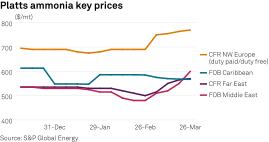
"Well, guess what? Ammonia prices [are] only going to get worse with all the limitations on LNG," Roman Kramarchuk, head of integrated narratives and policy analysis at S&P Global Energy, said during a CERAWeek session. As a result, "policymakers may put a short-term halt on ambitious efforts, because they're going to have to make sure that the planting season goes forward, that people are fed," Kramarchuk added.
Industrial gas producer Air Liquide had already dialed back its clean energy growth strategy in the US. In 2024, the company pledged to invest $850 million in equipment for ExxonMobil's blue hydrogen and ammonia development in Baytown, Texas. But ExxonMobil has yet to find a committed customer for the planned facility, and in November 2025, the project was shelved.
Air Liquide was also involved in six of the seven regional hydrogen hub projects that were awarded a combined $7 billion by the Biden administration. But the Trump administration has since paused or canceled those grants, and many of the projects are now dormant.
The company is still advancing clean hydrogen development in Europe, where the energy transition remains a "very strong focus," Air Liquide North America CEO Adam Peters said in an interview.
The Japanese government's support for low-carbon ammonia has also proven consistent, Peters added. But the crisis in the Middle East could alter the balance of sustainability, affordability and security concerns.
"Making sure that supplies are available in Europe, in my view, is going to take center stage for the moment over the carbon intensity of supply," Peters told Platts.
The impact on clean fuel investment is unclear, however, and will likely hinge on the length of the crisis, Peters said. "And I think that's a big question nobody knows."
During the March 25 panel, Ghiyati echoed Peters' remarks, emphasizing that the war in the Middle East is still recent and that market impacts may be temporary. Others predicted energy security concerns will only heighten.
"I tend to think that the world seems to be going in the direction of being more crazy, unfortunately," Clara Bowman, chief operations officer at synthetic fuels company HIF Global, added during the panel. "Hopefully, everything stabilizes that it doesn't become an issue. But that doesn't look the way that it's heading at the moment."
