Coal, Electric Power, Natural Gas, Energy Transition, Nuclear, Renewables
March 20, 2026
ANALYSIS: European power supply in better shape than 2022, but still lacks flexibility

Editor:
HIGHLIGHTS
Solar capacity has doubled, wind hits 300 GW
Nuclear has recovered, coal back in the money
Demand remains below pre-2022 crisis levels
European power markets have become more resilient to external supply shocks and are set to enter the summer 2026 season in much better shape than 2022, when Russia's invasion of Ukraine triggered price spikes due to the loss of Russian gas.
While the price impact of the current Middle East crisis may echo events in 2022, its direct impact on European electricity is different, even if the risk of higher prices may trigger intervention and long-term fallouts.
"We are not in a security of supply crisis, but we are in a price crisis," EU energy commissioner Dan Jorgensen said March 16, calling for EU member states to accelerate the expansion of homegrown energy and power grids to allow for more electrification.
Higher solar and wind capacity, the emergence of battery storage, improved French nuclear availability, but also industrial demand destruction and much slower emergence of new demand, mean that overall European power is well supplied.
"In 2022, the gas crisis triggered renewed ambition on the development of renewables as a means of accelerating Europe's move away from coal and gas. One result of that push has been an erosion of value for intermittent assets, particularly solar, as demand growth has not kept pace with renewable expansion," said Glenn Rickson, head of near-term European power analytics at S&P Global Energy CERA.
"Gas still plays a dominant role in power price setting. Therefore, in 2026, any new push on renewables must be accompanied by equivalent incentives to develop system flexibility and electrification of heating and transport demand, to both wean European consumers off oil and gas consumption and to minimize the risk of stranded intermittent renewable investments," Rickson added.
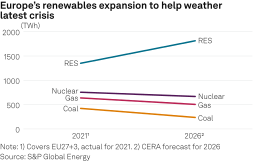
Overall, Europe's renewable power supply this year, compared to 2021, is forecast to increase by about 462 TWh, while demand still has not fully recovered to pre-crisis levels, according to S&P Global Energy CERA's annual planning case for end-2025.
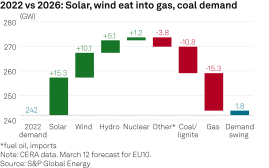
So far, renewables have mainly replaced coal, but higher gas and lower carbon prices are likely to trigger a temporary rebound for coal.
Battery boom may follow solar surge
Installed solar capacity across the EU27 doubled over the past four years to more than 400 GW, but growth is forecast to stagnate at around 60 GW.
Solar summer generation already exceeds gas-fired power generation across the bloc, but while higher power prices may limit the scope of negative hourly prices, curtailments are expected to increase, especially in saturated markets with limited storage capacity.
Hydro remains an important flexibility tool to balance solar peaks, while Europe's battery capacity keeps growing, but still lags behind solar.
Across Europe, about 30 GW of front-of-meter batteries and a similar amount of behind-the-meter batteries are now online, forecast to rise to 66 GW in 2028, according to CERA analysts.
This is underpinned by falling project costs, although some input prices may rebound. Lithium Carbonate CIF Europe has doubled since October to $20,000/mt, while solar modules (DDP Europe 5-50 MW) rebounded to $0.133/W by March 19, according to Platts assessments for S&P Global Energy.
Europe also now has over 300 GW wind installed with about 70 GW added over the past four years.
Onshore wind continues to dominate, with only 40 GW offshore, mainly across the North Sea, where another 10 GW is set to come online this year and next.
German onshore wind is set to add record capacity this year as a result of fast-tracking permits and a boost to support after the 2022 crisis.
Wind could become Europe's biggest source of electricity next year, assuming average wind speeds, and already accounts for 20% of Europe's power mix.
According to Eurostat, renewables accounted for 47.3% of EU power in 2025.
Solar, wind, battery capacity changes
| EU27+GB (in GW) | end-2021 | end-2025 | chg in GW |
| Solar | 180 | 390 | 210 |
| Onshore wind | 181 | 240 | 59 |
| Offshore wind | 26 | 39 | 13 |
| Battery storage | 8 | 54 | 46 |
Source: S&P Global Energy CERA (Connect, March 2026)
French nuclear reserves
Europe's nuclear capacity has declined by 6 GW since 2022, with new French and Finnish reactors offset by closures in Belgium and the UK.
France's nuclear fleet is in much better shape now, however, with nuclear availability already exceeding 400 TWh last year, compared to about 280 TWh in 2022 when dozens of reactors had to be taken offline for stress corrosion inspections and repairs. Long-term, France is also moving towards a final investment decision for six new reactors later this year.
Elsewhere, EDF and Centrica extended the lifespans of several British reactors, reducing gas demand by about 120 TWh between 2026-30.
Belgium extended the lifespan of two 1-GW reactors by 10 years, while Spain is considering an extension for 2-GW at Almaraz, partly for grid stability reasons after last April's blackout.
Nuclear will remain Europe's single biggest source of electricity this year with CERA projecting about 668 TWh generated across the EU27+3.
Coal closures, new gas plants
Coal and gas account for just over a quarter of Europe's electricity supply with the "thermal gap" shrinking by about 300 TWh over the past four years.
Within that gap, the higher gas/lower-carbon price scenario will incentivize gas-to-coal switching, despite Europe having closed over 40 GW of coal and lignite plants since 2022.
In addition, newer, more efficient gas-fired power plants not only offer more flexibility, but also require less fuel.
Some countries may also consider coal reserve plants for emergency supply measures if needed.
Clean dark spreads for coal are back in the money and well above clean spark spreads for gas, although generation economics differ significantly across European markets.
Carbon prices are key, with EUA carbon allowances down by a third since peaking above Eur90/mtCO2e in January.
Gas, coal, nuclear capacity changes
| EU27+GB (in GW) | end-2021 | end-2025 | chg in GW |
| Gas | 212 | 226 | 14 |
| Coal, lignite | 124 | 81 | -43 |
| Nuclear | 111 | 105 | -6 |
Source: S&P Global Energy CERA
Industrial demand destruction
Back in 2022, Europe's demand response to the gas supply crisis was the biggest factor in deflating prices after the first winter without Russian gas. A large chunk of that is now seen as permanent demand destruction in energy-intensive industries.
Power demand in 2025 was about 5% below 2021 and was forecast to recover above pre-crisis levels in 2027.
CERA analysts forecast a modest 1.5% demand rise in core markets in 2026, amid questions about the economic impact of the Middle East war on Europe's economy.
"The current situation has implications for both short- and long-term trajectory of power demand growth, and perhaps not both in the same direction. Wholesale price spikes will act as a severe brake on demand recovery for industry this year without government intervention, as energy-intensive sectors come under further cost pressure," according to CERA analyst Rickson.
"For the residential sector, the link between wholesale and retail will be key amid a number of policy measures considered and already implemented across the EU as well as the UK and Norway," Rickson added.
