Coal, Electric Power, Natural Gas, Energy Transition, Nuclear, Renewables
March 09, 2026
US POWER TRACKER: Midcontinent April power rises despite mild forecasts, weak gas

HIGHLIGHTS
Temperatures set to rise to 2-5 F above normal
Gas forwards fall 5.5%-6% from April 2025 spot
Coal set to lead share of average generation
April on-peak power in the Midcontinent Independent System Operator footprint has surged, despite mild weather forecasts and continued weakness in natural gas.
Industry observers differ on the causes for the strength of power forwards.
The Platts M2MS Power Forward curves March 6 had April on-peak power at five geographically dispersed locations averaging around $42.75/megawatt-hour, up about 5.8% from the April 2025 day-ahead on-peak locational marginal price that averaged around $40.60/MWh. In February, the April 2026 on-peak packages averaged around $41.65/MWh. Platts is part of S&P Global Energy.
Temperatures across MISO's 15-state footprint are expected to average 2-5 degrees Fahrenheit above normal in April, according to CustomWeather. In April 2025, CustomWeather calculated population-weighted temperatures to average about 1 F below the long-term average.
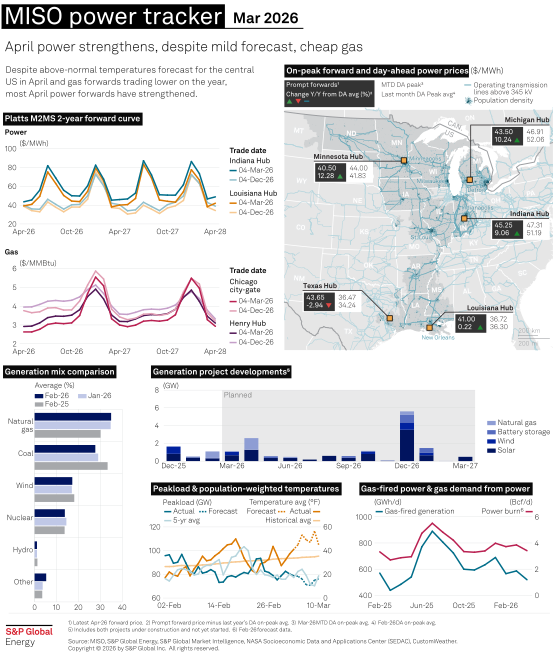
Platts forwards March 6 had Henry Hub April gas at $3.186/MMBtu, down 6% from the Platts April 2025 spot assessments, which averaged $3.391/MMBtu. In February, Henry Hub April 2026 gas averaged $3.391/MMBtu.
Tulane Energy Institute Associate Director Eric Smith said the war in Iran and related energy constraints may play a role in hedging April power price risks.
"In terms of the total natural gas supply available in the US, about 12%-14 % of supply is currently exported as LNG, with a bit more exported to Mexico as pipeline gas," Smith said in a March 9 email. "Export LNG is under long-term contracts but is indexed to aggregate prices in the international market for either US gas or for crude. So, it could see higher prices due to supply disruption."
But Campbell Faulkner, senior vice president and chief data analyst at OTC Global Holdings, a Houston-based interdealer commodity broker, said "It's hard to see ... motivation to immediately hedge power due to the Iranian war."
"It's not as though the US has a spare 10 billion cubic feet a day of idle LNG offtake ready to immediately step in to backstop the lost Qatari volumes," Faulkner said in a March 9 email. "A prolonged conflict could well provide uplift to domestic natural gas prices, which would then propagate into the power market given gas's relative importance in every US independent system operator. Even though there is not an expected large demand slug for MISO, the warmer weather of late, coupled with the move into maintenance season, seems to be pushing up MISO prices."
S&P Global Energy CERA's latest North American Electricity Short-Term Forecast indicates MISO load levels are likely to average about 74.7 gigawatts in April, up about 8.3 GW, or 12.5%, from 66.4 GW April 2025.
Gas generation, burn set to rise
The heavier loads are likely to result in stronger gas generation and power burn in April. The forecast is for the MISO gas fleet to produce an average of about 518.8 gigawatt-hours/day in April, up about 35.5 GWh/day, or 7.4%, from 483.3 GWh/d in April 2025. Assuming the latest available implied heat rate, this would result in a power burn of about 3.4 billion cubic feet/day, up 538 million cubic feet/day, or 18.7%, from 2.9 Bcf/d in April 2025.
Despite stronger output in the forecast, the gas fleet's share of MISO's average generation levels would fall to 29.3% in April, according to the forecast, from a projected 30.2% in March. The MISO coal fleet's share would continue to hold its large share of average generation levels in April at 30.8%, according to the forecast, down from March's forecast of 37.5%.
MISO's own actual data for February shows the natural gas fleet maintained its dominant share of 34.9%, up from 34.7% in January and 30.1% in February 2025. The coal fleet's share was 27.7% in February, down from January's 29% and 33.3% in February 2025.
MISO's wind fleet maintained its No. 3 spot in February, at 17.2%, up from January's 17% but down from 18.1% in February 2025. CERA forecast the wind fleet's share of average generation levels would be 17.7% in April, up from March's forecast of 14.2%.
MISO's nuclear fleet typically ranks in the top four of generation and is forecast to provide 14.2% of average generation levels in April, up from March's forecast of 11.2%. In February, MISO data shows the nuclear fleet provided 13.8% of total electricity, down from 14.5% in January and virtually flat with 13.7% in February 2025.
February prices fall
The MISO wind fleet maintained strong profitability in February, with its Platts-assessed Indiana Hub on-peak capture price index averaging $50.63/MWh, less than half January's $107.82/MWh average, but up 7.5% from $47.11/MWh in February 2025. A renewable power capture price index reflects the actual clearing price of power when intermittent renewable resources are generated, which changes throughout each day and by location.
January's capture price indexes reflected strong day-ahead on-peak LMPs, averaging about $89.45/MWh, driven by extreme weather, heavy loads, and strong natural gas prices, but February day-ahead on-peak LMPs at five geographically dispersed power hubs were down about 52% to about $43.15/MWh. February's prices were also down about 16.9% from about the $51.55/MWh average in February 2025.
MISO peakloads averaged less than 84 GW in February, down 7.2% from the January average of 90.5 GW and 2.1% from 85.7 GW in February 2025.
CustomWeather calculated MISO's population-weighted heating degree days in February to be down nearly 24% from January and 14% from February 2025. The National Weather Service defines a degree day as the difference between the average temperature in Fahrenheit (maximum plus minimum, divided by two) and 65 F.
At the Chicago city-gates, Platts-assessed spot gas averaged $3.347/MMBtu, down about two-thirds from January's average of $9.839/MMBtu and 17.9% from $4.076/MMBtu in February 2025.
Platts Henry Hub spot gas averaged $3.838/MMBtu in February, down 50.2% from the January average of $7.713/MMBtu and 6.3% from $3.875/MMBtu in February 2025.

Editor: