Electric Power, Energy Transition, Renewables
February 16, 2026
European battery revenue strategies evolve amid high solar penetration: panel

HIGHLIGHTS
Spanish market suited for co-located assets
Volatility drives stand-alone BESS capacity in Germany
Spanish capture prices at a discount
Increased instances of negative hours and solar cannibalization have led battery energy storage system asset owners and operators to adjust their revenue structures according to shifting renewable market dynamics, delegates heard during the 2026 E-world conference on Feb. 11.
"Over the last few years, we were already able to observe the amount of assets under distress increasing," said Max von Hausen, regional lead Power Purchase Agreement and BESS transactions at Pexapark, speaking during a BESS-focused panel.
"There were higher capture price assumptions than [were] actually realized and this distress on the assets led to assets not meeting their returns as expected and there is a refinancing pressure that overall will drive restructuring in the sector," he said.
Von Hausen added that this was visible particularly in Spain and the Nordics, where the organization also works on the termination of PPAs and restructuring of hedges.
Platts, part of S&P Global Energy, assessed the volume-weighted annual average capture price at Eur39.93/MWh in Spain in 2025, down 12% year over year.
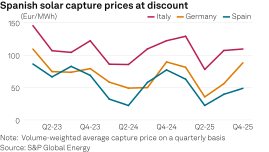
Higher levels of solar generation also saw an increase in negative hour occasions in Spain, with 411 instances recorded in the second quarter of 2025 alone, the highest of any EU10 market, system data showed.
In this instance, panelists said the Spanish market was increasingly favorable to co-location projects.
"For Spain [...] we see on a fundamental basis that, given the penetration of solar, given the grid congestion that you have in Spain, the negative prices [etc.], we think you have a better strategy with co-location in terms of BESS than going into a stand-alone facility," said Michael Sipos, senior investment manager at asset manager Reichmuth Infrastructure.
Speaking on how independent power producer Zelestra has navigated the highly saturated solar market, Martin Scharrer, origination director, said: "We need some other portfolio mixture [...] to get again to stable revenues because of the cannibalization. And the only way to do that is to invest in BESS. We do that in all our countries."
For that reason, Scharrer said, "we don't realize any PV solar project without any storage any longer. So that's a must."
This has led to an apparent preference for fixed-hedged revenue options for co-located BESS and solar in the Spanish market. This was evidenced by Pexapark data presented during the panel, which showed that all 400 tracked contracted deals in Spain in 2025 were co-located.
Volatility
In Germany, the vast majority of the more than 1,600 tracked contracted deals last year were for stand-alone merchant assets, according to Pexapark data.
"In Germany, the smaller part of stand-alone [assets] is looking into fixed price transactions where revenue is fixed hedged, helping debt financing. And the bigger part is actually assets that are going merchant and participating in the free markets," said von Hausen.
Scharrer echoed this sentiment, saying: "I would say from a stand-alone BESS project basis, the German market currently is the most interesting because the volatility in the German market is much higher than in the Spanish market."
With a number of battery assets in Germany under its portfolio at Reichmuth, Sipos said that their solution veers away from co-location and instead toward stand-alone assets.
"We faced pretty much the same challenges I think every operator of renewable energy has faced in the last years: we were confronted with large cannibalizations [and] we saw our revenue stacks basically declining quite sharply," said Sipos.
"We thought that on a global scale of the entire portfolio that we have had at that point in time, it makes more sense to implement one asset, which would 'anticorrelate' with the production revenues that we were making and with the swings that we have had."
"[This] led us to the conclusion that we should buy a battery storage asset, specifically in a market which would provide multiple revenue stacks [and] give us sufficient liquidity on the market side, as well as large enough volatility to be able to monetize the swings in assets that we were seeing in our portfolio," he said.

Editor: