Electric Power, Energy Transition, Renewables, Nuclear
January 23, 2026
Japan set for Feb 8 general election as energy security takes priority
HIGHLIGHTS
Incumbent, opposition stress energy security
Energy policy certainty to support long-term LNG role
Abolition of provisional gasoline tax yet to boost demand
Japan's Prime Minister Sanae Takaichi dissolved the House of Representatives on Jan. 23, calling a snap general election at a time when energy security is at the forefront of national priorities.
The general election will take place on Feb. 8, following an official announcement on Jan. 27, as decided by the government at its extraordinary Cabinet meeting on Jan. 23.
In a statement approved at the Cabinet meeting, the government said minimizing various risks, such as those related to energy and resource security, is among the priorities that need to be addressed.
During a Jan. 19 press conference announcing her decision to dissolve the House, Takaichi said, "Implementing measures to ensure a stable and affordable supply of electricity is essential for protecting our daily lives and Japan's industries."
"Promoting the widespread use of perovskite solar cells invented in Japan and the early social implementation of next-generation innovative reactors such as small modular reactors and fusion energy -- where Japanese companies hold technological advantages -- are necessary steps," she added.
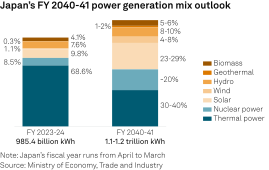
These measures align with the 7th Strategic Energy Plan -- Japan's principal energy policy -- formulated in February 2025, which indicates no major changes are expected in the country's energy policy direction after the election.
Similarly, the Centrist Reform Alliance -- a key opposition camp recently formed by the Constitutional Democratic Party of Japan and Komeito -- laid out its basic policy, including on energy.
It lists maximizing the use of renewable energy; restarting nuclear power plants whose safety has been reliably confirmed, while aiming for a future society that does not rely on nuclear power; as well as ensuring energy security and realizing a decarbonized society through the promotion of next-generation technology development.
Policy certainty
"If Sanae Takaichi meets her goal of consolidating her political base with the snap elections, it will reinforce her mandate and the policy framework that she has outlined, including strengthening energy security and support for nuclear energy," said Eric Yep, senior principal analyst for First Take Gas at S&P Global Energy CERA.
"This translates into political continuity for the goals of the Strategic Energy Plan and the critical role of LNG as a stable fuel source in the long run," he added.
"A strong political mandate and a concrete road map for economic growth also reinforce Japan's position as a long-term LNG importer, especially given the emphasis on stable and affordable energy supply," Yep said. "Gas importers will be able to renew and negotiate contract extensions with more certainty about domestic energy demand."
The Strategic Energy Plan projects that Japan will need 53 million-74 million metric tons of natural gas in its primary energy supply in fiscal year 2040-41 (April-March) across multiple scenarios, based on a target of 61%-73% reductions in greenhouse gas emissions from FY 2013-14 levels.
"[Takaichi] has committed to reversing austerity measures and boosting investment in critical sectors like technology and specialized solar and nuclear energy, including SMRs," Yep said.
"This signals strong growth in Japan's energy demand from sectors like data centers that will require stable fuels like LNG, even though nuclear restarts could accelerate. Her overall approach to energy policy comes across as pragmatic and strategic," he added.
SMRs
There are over 80 small and advanced modular reactor designs for SMRs globally at various stages of technical development.
However, those closest to commercial development are largely based on existing and established reactor technologies similar to those used in large nuclear units, relying mainly on light-water reactor technology.
While Japanese companies play a significant role in developing SMR technology, including the 300-MW GE Vernova Hitachi BWRW-300, there are currently no clearly established sites for SMR deployment in Japan.
The first SMR in the West is likely to be completed at Ontario Power Generation's Darling nuclear plant in Canada, possibly by the end of 2029. Well-developed SMR projects are also underway in the Czech Republic, Estonia, Poland, the UK and the US, with units expected to be generating power in these countries by the mid- to late 2030s.
Russia has operated a floating SMR, the Akademik Lomonosov, for several years. In China, one of the most advanced SMR projects globally is at the Shidaowan nuclear plant in Shandong province, where Chinergy is building two high-temperature gas-cooled SMRs.
Provisional gasoline tax
The Takaichi Cabinet highlighted the removal of the provisional gasoline tax as one of its major achievements since its formation in October.
Although the government removed the provisional gasoline tax of Yen 25.10/liter on Dec. 31, 2025, after gradually increasing its gasoline subsidy to the same amount on Dec. 11 to cushion the impact of the removal, traders said that the decline in retail gasoline prices has yet to boost consumer demand.
"Persistent inflation continues to erode consumers' appetite for purchasing goods, including gasoline, resulting in a decline in gasoline sales volume even after the increase in the gasoline subsidy," a trader in Chukyo said.
"We hope the new administration after the election will change some regulations in the transportation industry, which drags down sales volume by limiting the transportation capacity of oil products," the trader added.
"Political disruption after the election could significantly affect fragile consumer confidence, which is the last thing the oil product industry needs," a trader in Tokyo said.
The latest national average retail price for regular gasoline was Yen 154.70/liter on Jan. 19, down 10.8% from Nov. 10, 2025 -- just before the government began increasing the gasoline subsidy to Yen 25.10/liter -- according to the Oil Information Center of the Institute of Energy Economics, Japan.
