LNG, NGLs, Maritime & Shipping, Refined Products, Crude Oil, Wet Freight, LPG
October 19, 2026
India-US energy ties in spotlight as Rubio visits amid weaker US crude flows
HIGHLIGHTS
Rubio, Jaishankar to discuss energy, other issues Oct. 20
Rubio to visit Jamnagar amid rising Venezuelan crude flows
Jan.-Oct. average US crude flows down 43% YOY: CAS
Expanding energy cooperation between India and the US is expected to feature prominently in talks during US Secretary of State Marco Rubio's visit to India this week, with officials, industry sources and analysts citing the revival of US crude flows and broader cooperation in areas such as LPG as key priorities.
Rubio's visit to India — his second this year — comes as India seeks competitively priced crude oil and products while avoiding overreliance on any single supplier or region. This makes energy security — and the role the US can play in supplying crude, LNG, LPG, ethane and other feedstocks — an important test of whether the two countries can translate their broader strategic partnership into more resilient and commercially viable energy ties, they said.
India's External Affairs Minister S. Jaishankar is scheduled to hold talks with Rubio on Oct. 20, ministry spokesperson Randhir Jaiswal said Oct. 16, adding that the visit would provide an opportunity to review bilateral relations and discuss ways to further strengthen the Comprehensive Global Strategic Partnership.
"Discussions are expected to cover key areas of bilateral cooperation, including energy, trade, investment, defense, critical and emerging technologies and other areas of mutual interest. The two sides will also exchange views on regional and global developments," Jaiswal said.
Analysts and industry officials said the visit comes as US crude shipments to India have weakened in 2026 after robust flows in 2024 and 2025, underscoring the need to address competitiveness, freight costs and broader commercial factors influencing Indian refiners' purchasing decisions.
"Crude oil will remain the anchor of the India-US energy relationship," Premasish Das, executive director for oil analytics at S&P Global Energy CERA, said Oct. 16. "I don't see US crude replacing Middle Eastern or Russian barrels, but it has become an important part of India's diversification strategy, particularly because geopolitical tensions have exposed the risks of overreliance on any single region."
While freight rates will continue to influence the competitiveness of US crude in India, access to reliable supplies outside the Middle East has become increasingly important. At the same time, India is already a major importer of US LPG, LNG and ethane, and those trade flows have become even more important following disruptions in the Middle East, he added.
"As India looks to diversify supplies and strengthen energy security, the US has become a more important supplier across a range of commodities, from crude and LNG to LPG and petrochemical feedstocks. In that sense, the relationship is much broader today than it was a decade ago," Das said.
India's diversification strategy
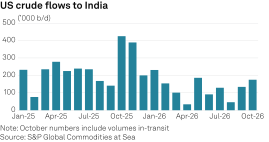
US crude oil flows to India averaged about 149,000 barrels/day in 2024, marked by a strong midyear surge followed by a second-half pullback. Flows were generally stronger but more uneven in 2025, averaging about 238,000 b/d, according to S&P Global Commodities at Sea data.
However, US crude flows weakened in 2026, averaging 128,000 b/d over January-October — roughly 43% below the 2025 average for the same period, CAS data showed.
Rubio, before departing for India, said New Delhi has taken steps to diversify its energy sources but continues to rely heavily on Russian supplies, adding that a shift away from them cannot happen overnight.
"You've got countries like India, for example, that have voluntarily diversified their energy portfolio but are still getting a substantial amount of energy from Russia because it's hard to pivot from one day to the next, but they're also an important ally and partner of the United States. We need time to sort of study all this and figure out what the right combination is," Rubio told reporters Oct. 17.
DLN Sastri, former director of oil refining and marketing at the Federation of Indian Petroleum Industry, said that while Rubio's visit to India comes amid uncertainty over US tariff threats and potential sanctions-related pressure linked to India's purchases of Russian energy, a changing US approach to Russian energy could ease pressure on India.
"India has been importing crude oil from the US and now from Venezuela too, which is of interest to the United States. Besides, [US President] Donald Trump has openly spoken in favor of Russia, so hopefully, Russian sanctions related to Indian trade are no longer an issue now," Sastri said.
Venezuelan oil flows to Reliance
According to a US State Department statement Oct. 13, Rubio will also visit Jamnagar during his trip to India, but it provided no details about the planned talks.
Debangsu Ray, cluster president and head of Reliance Industries Ltd.'s Jamnagar Refinery and Petrochemical Supersite, told Platts, part of S&P Global Energy, on Sept. 8 that Reliance can process crude from diverse regions, thanks to the advanced configuration and scale of its Jamnagar complex.
The refinery's Nelson Complexity Index of 21.1 — the highest in the world — gives it the flexibility to process almost all crude oil grades and meet increasingly differentiated and demanding product specifications in global markets. With crude processing capacity of 1.4 million b/d, the complex has so far processed more than 240 different crude grades, Ray said.
"Reliance is the largest buyer of Venezuelan crude and is likely to remain central to any US effort to expand Venezuela-India oil trade, given the company's refinery configuration and ability to process heavier grades," said Benjamin Tang, head of liquid bulk at CAS.
However, further growth may be limited by India's relatively modest heavy-crude processing capacity, with only a small number of refineries equipped to handle grades such as Merey-16, Tang added.
India imported about 300,000 b/d of Venezuelan crude in 2019, but flows have since declined to about 25 million barrels in 2024. In 2025, five VLCCs — one per month — discharged Venezuelan crude at the Port of Sikka, according to CAS data.
A total of 13.6 million barrels of Venezuelan-origin crude, including in-transit volumes, is expected to be discharged at Indian ports in October, after 10.2 million barrels were discharged in May, CAS data showed, highlighting a sharp near-term increase in flows. Completed inflows of Venezuelan crude to India have averaged 190,000 b/d so far this year, with 80% of the volume delivered to Sikka port.
