Crude Oil
May 20, 2026
Venezuela debt restructuring may take years, but progress could boost oil investor confidence

By Kate Winston
Editor:
HIGHLIGHTS
Risk ranking could improve over next five years
Infrastructure, workforce, governance challenges remain
Venezuela's external debt at $150-$200 billion
Venezuela's plans to restructure its sovereign and oil company debt could take years to come to fruition, but movement toward that goal could still boost investor confidence in the oil sector in the meantime, experts say.
In the next nine to 12 months, financial markets are likely to come up with creative solutions to start to restructure Venezuela's debt and improve the oil sector's perception of the country's risk, said John Haley, a partner at the law firm Nelson Mullins.
"Can everything be repaid before operators go back in? It's just not feasible," Haley said. "So I think it's something that needs to be done on parallel tracks."
Venezuela is among the highest-risk countries in the world for oil and gas investment, according to S&P Global Energy CERA analysts. But in the wake of US intervention, Venezuela's ranking will improve considerably over the next five years, placing the country in the top 60% of rated jurisdictions by 2030, according to a March report.
"Risks related to sanctions, fiscal terms, contractual awards and regulatory approvals are improving quickly as the authorities enact policies affecting these issues," the report said.
The Venezuelan government, on May 13, announced a comprehensive process to restructure the country's external public debt and the debt of state-owned oil company PDVSA.
Venezuela's crude oil output averaged 1.130 million b/d in April, up 4.8% from March. PDVSA aims to reach crude oil production of 1.37 million by the end of this year, PDVSA Executive Vice President Jovanny Martinez said in April.
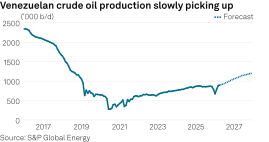
Venezuela is also updating production participation contracts in line with its new hydrocarbons law in order to boost production.
Lengthy restructuring
Sovereign debt and the debt of state oil company PDVSA are intertwined, Haley said. "On the oil and gas obligations that are owed to operators or big oil, there has to be some sign that those are going to be addressed."
It took years for Argentina to restructure its debt, but the process may be faster in Venezuela because it is a US focus area, Haley said. And if market forces are also ready to invest in the region, political forces will align, he said.
Both development banks and private markets will be involved in debt restructuring in Venezuela, Haley said. It is too early to tell whether the US will provide funds, he said.
Rachel Ziemba, a senior adviser with Horizon Engage, said that Venezuelans will argue for swift restructuring but will disagree with bondholders over the degree of write-downs.
"I anticipate this could take well into 2027," she said.
Others say that the debt restructuring process will take years.
Philip Luck, the director of the economics program at the Center for Strategic and International Studies, says that the debt restructuring process will be exceedingly complicated.
"Liabilities are likely close to 200% of GDP. Past precedent puts the average time that restructurings of similar scale take at around 30 months," Luck said. "And Venezuela has additional complicating factors, including the large share of debt held by China, which recently significantly slowed the restructuring processes of Zambia and Sri Lanka."
S&P Global Ratings analysts said in an April 27 report that Venezuela's external debt burden was estimated between $150 billion and $200 billion across sovereign and quasi-sovereign obligations.
Ted Borrego, an energy attorney based in Texas, says the biggest share of debt is owed to private bondholders, but there is also a chunk owed to Russia and China and another chunk owed to oil companies due to expropriation.
The Russian, Chinese and oil company debts could be discharged via crude oil payments instead of cash, Borrego said. But to allow crude to be used as a form of payment, the Trump administration would have to be involved, he said. The process will likely take a year or two, he said.
"In some respects, this resembles a large bankruptcy and trying to figure out which creditors take priority (if any), and what can be used as a payment, in kind, probably, since nobody really wants to stock up on bolivars, will be a real headache," Borrego said.
Other investment hurdles
Debt restructuring is necessary to unlock oil sector investment, but it is not sufficient, Luck said. Venezuela still faces significant challenges in its physical infrastructure, human capital, and the governance of both the oil industry and the country writ large, he said.
Investors also need to price in the possibility of sanctions snapback, especially since the regime in Venezuela is largely unchanged, Luck said.
Iran sanctions relief in 2016 did not lead to the flood of investment that many analysts and policymakers had hoped for, because the business community rightly worried about the political commitment to that relief, he said.
"I would expect something similar here without broader changes to the regime's behavior," Luck said.
Long-term investment is also complicated by the uncertain outlook for longer-term demand, Ziemba said. "Current oil prices are attractive and encourage as much product as possible to market, but the same companies active in Venezuela are also those cautious about significant investment ramp-up in the United States."
In addition to infrastructure repairs and workforce shortfalls, oil operators must consider that armed gangs, militias and rebels in oil-producing areas may see oil company personnel as either targets or ransom-producing assets, Borrego said.
Some smaller operators and service companies are likely willing to take the risk, even now, Borrego said.
"The big guys? There are so many other places that they can make money that going back to Venezuela is going to be a real stretch," Borrego said. "There are a lot of places in Latin America that are much more attractive (e.g., Guyana, just next door) or in the rest of the world that don't have the problems inherent in Venezuela."
