Crude Oil, LNG
May 19, 2026
South Korea and Japan to strengthen crude, LNG supply security cooperation
By Gawoon Vahn and Takeo Kumagai
Editor:
HIGHLIGHTS
Leaders reaffirm energy security importance during summit
Both diversify oil sources beyond Middle East, boost US crude imports
Leaders discuss joint strategies amid global energy instability
South Korea and Japan have agreed to further strengthen cooperation on crude oil and LNG supply security, which are core energy sources for East Asia's top three economies, the South Korean presidential office said in the government policy briefing report May 19.
South Korea's President Lee Jae-myung hosted a summit with Japanese Prime Minister Sanae Takaichi May 19 and the two leaders reaffirmed the importance of South Korea-Japan cooperation for energy supply security and trade flows, the Presidential office Cheong Wa Dae said in the government briefing report.
Based on the 'LNG Supply and Demand Cooperation Agreement' signed last March, "we agreed to expand LNG cooperation between the two countries, and deepen information sharing and communication channels related to crude oil supply, demand, and stockpiling," President Lee said during a joint South Korea-Japan press conference in the late afternoon Seoul time.
South Korea and Japan are among Asia's big four economies and are ranked the world's fourth- and fifth-largest crude importers, respectively, according to data from state-run Korea National Oil Corp. and Japan's Ministry of Economy, Trade and Industry.
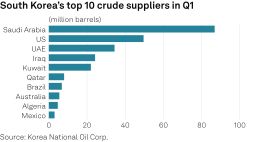
In addition, the Middle East accounted for around 94% of Japan's crude oil imports in 2025, while 69% of South Korea's crude imports last year were sourced from the Persian Gulf, according to KNOC and METI data.

"We shared the understanding that the need for close cooperation between our two countries has grown even greater regarding the instability of supply chains and energy markets stemming from recent developments in the Middle East," Lee was quoted as saying in the briefing report.
Major refiners in both South Korea and Japan have been actively buying spot crude cargoes from the Americas in recent trading cycles to diversify their supply sources beyond the Middle East.
South Korea - Asia's largest buyer of US crude - imported 49.6 million barrels of mostly WTI Midland, West Texas Light, and Mars Blend from North America in the first quarter, marking a record high for US crude procurement in January-March, according to KNOC data issued April 27.
Japan imported 80,948 b/d of mostly WTI Midland and West Texas Light crude from the US in Q1, more than double the 39,071 b/d purchased a year earlier, METI data issued April 30 showed.
Japanese Prime Minister Takaichi also proposed that South Korea and Japan work closely to deepen resource supply chain cooperation with other Asian countries experiencing supply chain crisis, Cheong Wa Dae said, adding that President Lee expressed his intention to actively participate in this effort.
President Lee and Prime Minister Takaichi, as strategic partners, discussed various pending issues, drawing on the trust between the two leaders built through shuttle diplomacy, to jointly respond to the rapidly changing international situation, Cheong Wa Dae said in the briefing report.
"We also emphasized the importance of South Korea-Japan and South Korea-US-Japan cooperation for regional peace and stability," President Lee was quoted as saying in the briefing report. "The recent elevation of the South Korea-Japan Security Policy Consultation to the vice-ministerial level for the first time is a very meaningful step forward."
