Refined Products, Jet Fuel
May 08, 2026
Europe can explore US jet fuel to ease supply crunch from Middle East war
By Samyak Pandey and Janet McGurty
Editor:
HIGHLIGHTS
Europe eyes US jet fuel amid supply crunch
Jet fuel prices surge 50% since conflict began
US production hits record, Nigeria emerges
European airlines could gain access to additional jet fuel supplies by using US-grade fuel as the prolonged Middle East conflict threatens to create shortages in the region, according to guidance issued by international aviation bodies and regulators on May 8.
The International Air Transport Association warned that continued fighting between the US, Israel and Iran could soon lead to fuel shortfalls in parts of the world, prompting the organization, EC and the European Aviation Safety Agency to issue technical guidance on how US-grade Jet A fuel could supplement traditional Jet A-1 supplies in European markets.
The EU confirmed there are no regulatory obstacles to the practice, provided it is managed safely across the fuel supply chain.
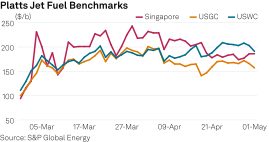
The guidance comes as jet fuel prices in Europe have jumped about 50% since the conflict began in late February, with the Strait of Hormuz remaining closed and stocks in the Amsterdam-Rotterdam-Antwerp hub falling to six-year lows. IATA Director of Flight and Technical Operations Stuart Fox said that if the war continues, "it won't be long before we see fuel shortfalls in parts of the world."
The guidance is a direct response to a supply crisis triggered by the de facto closure of the Strait of Hormuz, which has reduced energy exports from the Gulf region "to a trickle," the European Commission said.
Operational framework
Commercial aviation runs on two principal fuel grades: Jet A-1, the global standard used in most international operations, and Jet A, primarily used in North America. The two are closely related forms of kerosene, but are not identical. The critical operational difference is their freezing point. Jet A-1 has a lower maximum freezing point of -47°C compared with -40°C for Jet A, giving aircraft operating on Jet A-1 greater flexibility on long-haul and polar routes, as per EU directive.
Airlines in North America already manage this difference daily, relying on established procedures and, where needed, fuel additives to ensure Jet A performs safely even at extreme cold — including routes serving communities like Fairbanks, Alaska, where ground temperatures regularly reach -30°C and cruising altitudes drop below -50°C.

EASA warned that if Jet A were introduced without careful management, it "could result in an aircraft flying outside of its safe operating limits," with risks "further exacerbated by inconsistent fuel grade availability across airports, increasing the likelihood of mixing fuel grade and associated assumption mismatches".
Supply and demand context
The guidance arrives as European jet fuel inventories have deteriorated sharply.
Stocks of jet fuel and kerosene in the Amsterdam-Rotterdam-Antwerp hub drew 3.1% to 579,000 mt in the week to April 23, a new six-year low, 32% lower than the same week a year earlier, data from Insights Global showed.
They were last recorded lower at 574,000 mt at the beginning of April 2020, at the height of the pandemic-demand collapse.

Around 40%-44% of Europe's jet fuel imports originated from the Persian Gulf in 2025, according to S&P Global Commodities at Sea data, making the region acutely exposed to the Hormuz disruption.
Shock management
The price surge has already forced significant capacity reductions across global carriers.
Lufthansa Group said April 22 it would remove 20,000 short-haul flights from its schedule through October 2026, equivalent to 40,000 mt of jet fuel, with the group saying jet fuel prices have doubled since the outbreak of the Middle East war.
KLM said April 23 it would operate 80 fewer return flights within Europe over the coming month, citing routes that are "no longer financially viable" due to rising jet fuel costs.
Cathay Pacific consolidated around 2% of total passenger flights from mid-May through end-June, with its low-cost unit HK Express cutting 6% of frequencies.
United Airlines has warned that if prices remained elevated, "it would mean an extra $11 billion in annual expense just for jet fuel."
US shores up output
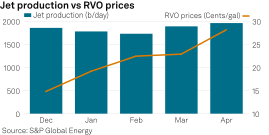
US Gulf Coast jet fuel production rose to an all-time high in the week to April 24, at 1.210 million b/d, according to US EIA data.
Total US production rose to its second-highest level on record at 2.034 million b/d, up 194,000 b/d year on year.
S&P Global Energy CERA analysts noted in their May North America Short-Term Outlook that "the jet market is where the global disruption is most visible," with the US having become "the primary shock absorber for global supply disruptions" as curtailed Middle Eastern exports push Europe to draw more heavily on US barrels.
Nigeria has also emerged as a critical alternative supplier.
West Africa jet fuel exports hit 329,000 mt in April 2026, according to S&P Global Commodities at Sea, up from just 61,000 mt in April 2024.
Northwest Europe received 38,000 mt from West Africa in April, while the Mediterranean took 135,000 mt, a stark contrast to the same period last year when both regions recorded zero flows from the region.
The ramp-up is being driven primarily by Nigeria's Dangote refinery, which began exporting jet fuel in April 2024 and is now running at maximum capacity.
Platts, part of S&P Global Energy, assessed US Gulf Coast jet for Colonial Pipeline's 27th cycle at $4.0961/gal on April 29, down by 68.50 cents/gal from an all-time high on April 2, but remaining elevated by $1.7101/gal since Feb. 27.
