Crude Oil
May 07, 2026
Norway’s DNO plans 4 more oil fields in North Sea as north Iraq output declines

Editor:
HIGHLIGHTS
DNO will add four North Sea fields by 2029
North Sea output jumps to 88,647 boe/d in Q1
Iraq production falls amid war disruptions
Norway's DNO plans to add four North Sea oil fields to its upstream operations by 2029, while production and investments in northern Iraq will be lower than planned in 2026 after fields were temporarily halted when the US-Iran war started, the company said in a May 7 earnings statement.
North Sea net production soared in the first quarter to 88,647 barrels of oil equivalent/day from 19,296 boe/d in the same period a year earlier, while output in Iraq's Kurdish region fell to 39,600 boe/d from 61,561 boe/d over the same period, the company said in the statement. The Symra field, one of the four North Sea fields to come onstream by 2029, started its first two wells in April, nine months ahead of schedule, it said.
North Sea revenue rose to $586 million in Q1 2026 from $129.9 million in Q1 2025, while Kurdish revenue in Iraq dropped to $41.20 million from $57.70 million over the same period, according to the statement. The realized oil price in the Kurdish region was $31/boe, down from $34.70/boe in the year-earlier period, while the North Sea price for oil was $87/boe in the first quarter of 2026, up from $77.90/boe in the first quarter of 2025, it said.
Kurdish production restarted on April 9 after a halt to output and drilling at the start of the war on Feb. 28, it said. "Reflecting the shutdown and outlook uncertainty, 2026 production and investments are expected to be lower than originally planned," the company said in its earnings presentation.
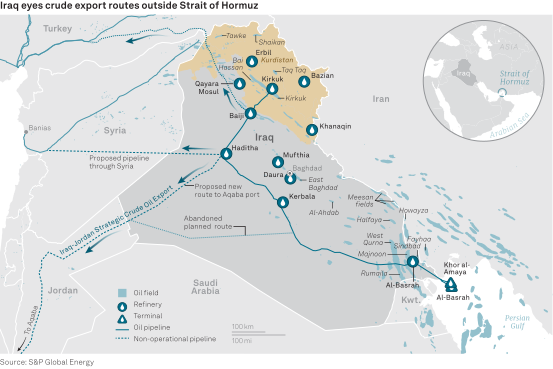
The plan depends entirely on what happens to the new government being formed in Iraq and to the oil pipeline agreement between Iraq and Turkey, which expires at the end of July, Executive Chairman Bijan Mossavar-Rahmani said during an earnings call. "If you give me those inputs, I can give you the outputs that you're looking for," he said.
There is still no renewal contract for the pipeline to Ceyhan in Turkey, Mossavar-Rahmani said.
"What will replace it, we don't know. It's still a work in progress, and what the implications of that are."
While other companies operating in the Kurdish region have a "different price plan and export plan than ours" since last year, DNO chose not to participate, "in part because we were able to receive payments from our buyers in advance of our actual sales. We called it cash and carry," he said.
The Tawke license in northern Iraq added two drilled wells to onstream operations in the quarter, while it resumed drilling on eight wells, it said. "Since last year's drone attacks, DNO has installed concrete walls with a total length of 2.8 kilometers to protect people and vital facilities at the Tawke and Peshkabir fields," it said.
The company is "preparing for stepped-up rates of production from Tawke and Peshkabir fields when security and market conditions improve," it added.