Refined Products, NGLs, Chemicals, LPG
May 05, 2026
US LPG exports hit record high in April on curtailed Hormuz Strait traffic: CAS

By Ashok Dutta
Editor:
HIGHLIGHTS
China and Japan top buyers during month
Effective closure of Strait boosts US LPG demand
US share of global LPG market grows to 50%
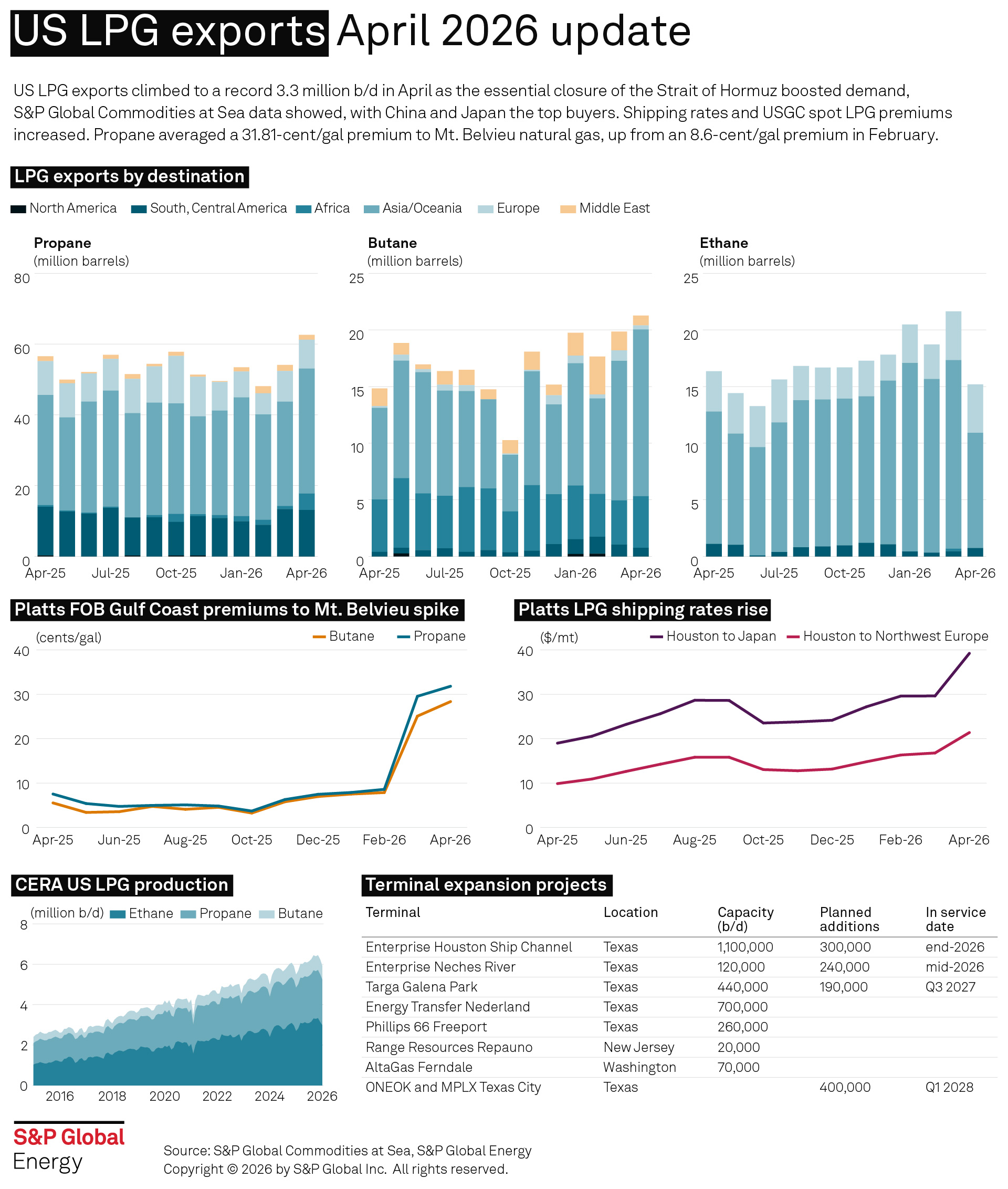
US LPG exports climbed to a record high of 3.3 million barrels/day in April, led by propane, as the continued effective closure of the Strait of Hormuz has boosted demand for US barrels, S&P Global Commodities at Sea data showed on May 5.
China and Japan were the single largest buyers of US LPG in April -- the US exported 457,000 b/d of LPG to China and 460,000 b/d to Japan.
The growing interest from buyers in Asia -- which also includes India, which in late 2025 signed its first deal to import 2.2 million metric tons of LPG in 2026 -- comes at a time when substantial volumes of LPG exports out of the Middle East are impacted by curtailed movements through the Strait of Hormuz.
"We have not seen the supply disruption that we see now, and that creates various opportunities that Enterprise is working to capture," Enterprise co-CEO Jim Teague said on the company's earnings webcast in late April.
From a global perspective, NGL demand remains structurally strong, and recent geopolitical dynamics have further reinforced the attractiveness of US supply, ONEOK Chief Commercial Officer Sheridan Swords said in late April.
"Refreshed request for capacity on our announced LPG export dock was already increasing and has accelerated more recently as customers look to diversify supply toward the US," he said.
Advancing new export facilities
NGL fractionators and LPG exports from the US are already working on new facilities along the Gulf Coast to further enhance North America's role as a global supplier alongside the Middle East.
Enterprise is nearing completion of a second-phase development of its Neches River Terminal 'flex' ethane and propane terminal with a capacity of 360,000 b/d of propane in Orange County. Besides, it is also working on a start-up in the last quarter of 2026 for the EHT LPG expansion project, a 300,000-b/d expansion of propane and butane loading capacity at the Enterprise Hydrocarbons Terminal in Texas.
Also, work is underway on Phase 1 of ONEOK's Medford NGL fractionator, which will add 100,000 b/d of Mid-Continent fractionation capacity in the fourth quarter of 2026, while the company is also progressing with construction work for the 400,000-b/d Texas City LPG export terminal in Galveston County, with start-up in early 2028.
US in 'catbird' seat:
Enterprise Products Partners, a leading US exporter of LPG, anticipates demand for its LPG supplies to global markets will remain strong and grow 300,000 b/d each year, primarily driven by heating demand and human needs.
"This is 'sticky' demand in non-OECD nations that have a lot of room to grow," Enterprise's Senior Vice President Corey Johnson said mid-April. "In addition to that, you continue to see petrochemical demand, especially given what's recently happened in the Middle East. The de-stocking of polymers and then also the consumption of stored feedstocks is going to provide a long runway for a lot of demand to come into the future."
"Price creates supply and price creates demand. When we look at our NGLs, we expect to see 900,000 b/d of growth in 2030 from our 2025 mark at 3.8 million b/d," Johnson said, noting the estimate is about 200,000 b/d over the company's previous forecast.
The US currently accounts for about 47% of global supply, with nearly 65% of that demand in Asia, Johnson said, pointing out that a bulk of the consumers are lining up for supplies of US light end products, which include ethane and propane.
"We obviously are in the catbird seat from a supply perspective when it comes to price," Johnson said. "International markets will always reach for the US barrel first."
About a decade ago, the US accounted for about 25% of the global LPG waterborne market, Johnson said, adding that, at present, that figure has risen to 50% of the overall market.
"Most of this is driven by residential market demand on the global market, but it is also being driven by a lot of growth in petrochemical demand as well," Johnson said. "Very well diversified, and again, quite sticky demand. We expect that to continue."
