Crude Oil
May 05, 2026
North Sea oil and gas in focus as Scotland heads to polls

Editor:
HIGHLIGHTS
SNP frames poll as mini independence referendum
Industry blames 'windfall tax' for declining output
Scottish fields underpin key Dated Brent benchmark
Voters in Scotland head to the polls for a legislative election May 7 that the ruling Scottish National Party is framing as a mini referendum on independence from the UK, which could have implications down the line for North Sea energy policy and the crude grades that underpin the Dated Brent oil benchmark.
The election for the Scottish parliament sitting in Holyrood has put a spotlight on energy policy, with the impacts from the wars in Ukraine and Iran pushing energy security near the top of the agenda.
The SNP, leading in the polls, has recently softened its stance on new drilling in Scottish waters after years of resistance, while Reform, a new force in British politics currently polling second, advocates for maximizing North Sea production while remaining part of the UK.
Labour, which controls the UK's national parliament in Westminster and is polling third in Scotland, has noted in its pre-election manifesto that "oil and gas production will continue in the North Sea for decades to come."
"It is looking highly likely that there will be a significant majority in favor of independence in the Scottish parliament," Graham Leadbitter, the SNP's energy spokesperson in the Westminster parliament, told Platts -- part of S&P Global Energy -- in a recent interview. If so, "the UK government has a question to answer," he said.
That could have major implications for the regulatory, tax and drilling environment in the North Sea. SNP minister Mairi McAllan said last month of further drilling: "If it can be demonstrated that it's both climate-compatible and required for energy security, then yes it should [happen]."
The election comes as crude prices have skyrocketed amid the war in Iran. Platts last assessed Dated Brent at $117.95/b on May 1.
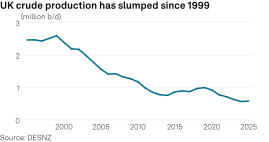
Production declines
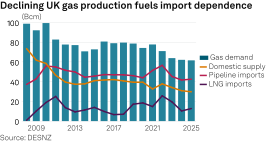
Most of the UK's oil and gas extraction occurs in Scottish waters. The UK produced 619,000 b/d of crude oil in February, according to provisional data from the Department of Energy Security and Net Zero, a far cry from a peak of 2.6 million b/d in 1999. Gas output has fallen similarly this century and stood at 29.68 Bcm in 2025, according to provisional DESNZ data.
Although the North Sea is a mature basin, industry players have attributed the declines to exploration bans and a challenging fiscal environment, particularly the Energy Profits Levy.
The EPL -- a windfall tax -- has raised the effective tax rate in the UK North Sea to 78%, driving consolidations and exits by large players. Storied British major BP is considering offloading its UK assets, according to recent news reports.
Meanwhile, the UK government is yet to approve two key projects, Adura's 70,000 b/d Rosebank field and Shell's Jackdaw gas project, both expected online by next year.
The Treasury says the EPL brings in billions to the Exchequer, but has laid out plans to replace it with a more pragmatic price mechanism. It also said it would allow tie-backs to extend the lifespans of existing fields. However, amid the Iran war, energy secretary Ed Miliband branded BP's first quarter profits "morally and economically wrong."
The SNP's Leadbitter told Platts the UK should scrap the EPL to prevent job losses, adding that it has "passed its sell-by date" and is failing to meet its own revenue aims by pushing producers out of the basin.
As a result, Scottish independence could have a significant impact on policy and production, with sector management handed to Edinburgh.
Lobby group Offshore Energies UK estimates that scrapping the EPL could unlock GBP41 billion of North Sea investment between now and 2050. "Scottish support for Scottish industry matters. It is time for all political parties to back our sector, and by proxy back a modern, industrial Britain secured by homegrown energy," OEUK said in a statement.
The discussion comes amid surging demand for European crude. Heavier grades like Kraken and Captain are potential substitutes for shut-in sour Gulf crudes.
Light sweet Forties crude was last assessed by Platts at a $6.65/b premium to Dated Brent on May 1, down from a record high of over $21/b in mid-April.
However, a renewed push for Scottish independence could also lead to policy uncertainty -- including the regulatory, drilling, licensing and tax environment and decommissioning schedules -- with implications for investment inflows.
Benchmark impact
An independent Scotland would have a stake in Dated Brent, the global oil price reference point. Among the basket of grades that comprise it are UK grades Forties and Brent, which load from mainland Scotland and the Shetland Islands respectively.
Both load on a free on board basis, meaning independence would be unlikely to impact benchmark methodologies unless Scotland nationalized the oil sector and set prices. The SNP has never expressed a desire to do so.
A shift in energy policy and investment could, however, impact how much oil is available. Low UK production volume was one factor behind Platts' decision in 2022 to include US WTI Midland crude in the Dated Brent basket.
Brent and Forties exports have slumped from a combined 350,000 b/d in 2019 to 175,000 b/d last year, the vast majority of it Forties, according to data from S&P Global Commodities at Sea. The biggest buyers were Poland, China and Germany.
Independence could also raise questions around transit arrangements for Norwegian and UK pipelines and the validity of existing North Sea licenses. Some Norwegian grades, such as Ekofisk -- which is also in the Dated Brent basket -- flow through Scottish infrastructure for export.
However, market participants note that such an outcome remains a distant prospect.
One well-placed Scottish industry source told Platts that comments from politicians of all parties demonstrate that "oil and gas's position in this election is more as a potential club to beat their opponents with" rather than "a policy area where there are serious alternative proposals."
"Holyrood is mood music, but Westminster continues to call the tune, so industry eyes remain on London rather than Edinburgh," the source added.
