Crude Oil
April 28, 2026
FACTBOX: UAE, OPEC's third largest producer, charts new course outside bloc
By Charlie Mitchell and Lauren Holtmeier
Editor:
HIGHLIGHTS
Country pumped 12% of OPEC output in Feb
Murban, Upper Zakkum grades popular in Asia
The UAE said April 28 it will leave the OPEC producer group and OPEC+, the bloc's alliance with Russia and several other producers, effective May 1, in a statement on state news agency WAM.
The Gulf state, which joined OPEC in 1967 and has long been one of its most important members, said the decision was based on its "national interest" and commitment to "meeting the market's pressing needs."
It comes two months into the US-Israeli war on Iran, which has resulted in hits on Gulf energy infrastructure, including in the UAE, and the effective closure of the critical Strait of Hormuz shipping route.
The following are key facts about the UAE and its role in OPEC+ and the global oil market.
Infrastructure
- The UAE is OPEC's third largest producer after Saudi Arabia and Iraq, pumping 3.47 million b/d of crude in February, according to the Platts OPEC+ Survey from S&P Global Energy. However, that dropped to 1.91 million b/d in March, the first full month after the war began, with supply through Hormuz constrained.
- Its February production was equal to 12% of OPEC's total 28.86 million b/d output, and 8% of OPEC+'s total output.
- The country provides around 3% of global oil supply.
- The UAE has previously lobbied for a higher quota within the bloc, receiving a 300,000 b/d boost in 2024 after long stressing its large volume of spare capacity offline. It is also one of the so-called Group of Eight undertaking voluntary production cuts.
- The UAE's OPEC+ quota of 3.411 million b/d compares to its production capacity of 4.85 million b/d. ADNOC is currently carrying out a plan to boost its production capacity to 5 million b/d by 2027. In its statement April 28, the country said it has "invested to meet evolving demand efficiently and responsibly, prioritizing stability, affordability, and sustainability."
- The UAE pumps crude from onshore and offshore fields. TotalEnergies said April 10 it had lost oil and gas production in the UAE offshore, with infrastructure hit amid the Iran war.
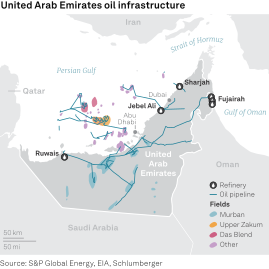
- The country's main downstream asset is the Ruwais hub, operated by state oil company ADNOC, which has two distinct refineries with a combined throughput of 834,000 b/d. Ruwais is currently operating at reduced capacity, after it briefly suspended operations as a matter of precaution following a drone attack March 10.
- Its second largest asset is the Jebel Ali refinery, operated by ENOC with 185,000 b/d capacity, according to data from S&P Global Energy analysts.
- It also has refineries in its key shipping hub of Fujairah, which is the terminus of the 1.5 million b/d Habshan pipeline that carries Murban crude from Abu Dhabi to an ADNOC terminal.
Trade flows
- The UAE is a key supplier of crude to Asia and other markets, finding buyers in Japan, India, China, Singapore and Malaysia, according to CAS data.
- Its Fujairah and Zirku Island loading terminals are the two largest, although exports from Fujairah in the Gulf of Oman have risen during the war, while terminals west of Hormuz have seen flows slump, according to CAS data.
- ADNOC's medium sour Upper Zakum crude has an API gravity of 33.9, according to the Platts Periodic Table of Oil. Exports climbed as high as 1.2 million b/d in February, CAS data show. An expansion is underway at the Upper Zakum field.
- Murban, typically favored for exports, had been increasingly held back for domestic refining in mid-2025 as its value relative to heavier crudes, like Upper Zakum, declined. ADNOC's Mubarraz, light sour Umm Lulu and Das Blend crudes, alongside Emirates National Oil Co.'s medium sour Dubai, make up smaller export volumes from the UAE.
Prices
- Crude prices have surged since the war in Iran began on Feb. 28, with Platts Dated Brent rising above $144/b in early April. Platts last assessed Dated Brent at $113.79/b on April 27.
- News that the UAE is quitting OPEC did not have a major impact on oil prices, with the market closely monitoring more urgent developments in the conflict, specifically around potential US-Iran peace talks. Front-month ICE Brent futures were up 3.1% on the previous close to $115.59/b at 1440 GMT.
- Platts Dubai -- the key Middle East sour crude benchmark -- was assessed at $107.20/b on April 28, up 2.9% from the previous day. The benchmark typically comprises Murban, Upper Zakum and Das Blend, alongside two other regional grades.
- Grades that cannot be physically delivered outside the Strait of Hormuz, including Upper Zakum and Das Blend, were suspended from the basket shortly after the Iran war broke out.
- In January, Platts changed its methodology for Murban crude. The grade can now be assessed without a floor to the benchmark Platts Dubai assessment, meaning it can be assessed above, at parity with, or below Dubai and other medium sour grades in the basket. However, as regional war broke out in March 2026, that negative quality premium option was suspended to maximize the volume of deliverable crude to global markets.
