Crude Oil
April 20, 2026
Trading houses 'less stressed' by Middle East crisis due to deeper funding access

Editor:
HIGHLIGHTS
Lead traders had buffer of record 2022-23 profits
Lenders 'more proactive' on offering working capital
Trading from non-oil specialists adds to volatility: Citadel
Trading houses were better poised to capitalize on the energy price volatility linked to the war in Iran after years of windfall profits, according to leading industry players and institutional investors, who say markets are quickly adjusting to a faster rate of the commodities cycle and black swan events.
When the war in Iran plunged the world into its second energy crisis in the space of five years, the world's largest commodities traders were in a strong position to embrace market risk, Sebastian Barrack, Head of Commodities at US hedge fund Citadel, told the FT Commodities Global Summit on April 20 in Lausanne, Switzerland.
After the outbreak of the Russia-Ukraine war, and previously the Covid-19 pandemic, the world's leading private traders – Vitol, Trafigura, Mercuria and Gunvor – achieved record results, booking net profits of around $50 billion combined between 2022-23. As a result, the traders amassed deep capital reserves that have left their operations "much less stressed" by the current crisis, Barrack said.
"The biggest difference here is that back 3-4 years ago the industry itself was facing some funding constraints," he said, estimating that initial margin calls increased fifteenfold in 2022. "Trading houses themselves were really pushed to the brink of funding capabilities," he said.
In contrast, two of the largest players were able to extend their funding lines within the first week of the Iranian conflict, he said, exhibiting a stronger ability to access capital.
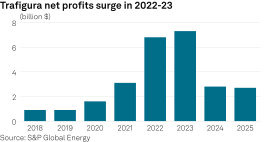
Faster commodity cycles
Also speaking at the event, Deia Markova, Executive Director of Finance at Swiss-based commodities trader BGN, said that traders and financiers had become better accustomed to navigating market shocks, allowing lenders to adopt a more proactive stance in offering liquidity and working capital.
"Until 2020, there were commodities cycles between every 10 and 15 years... black swan events might be once or twice in your career," she said. In contrast, markets have since "gained a lot of maturity" on how to manage such shocks from both a trading and banking perspective, she said.
Christine Dirringer, Global Head of Trade and Commodity Finance at Rabobank, agreed that banks had been more proactive in engaging with traders to mobilize funding, noting that the industry quickly began war-gaming the steps needed for counterparties if crude prices reached $170/b.
"Our primary source of funding is the banks, but there are some constraints – in a $100/b environment every single transaction requires additional capital," said Antoine Sevray, Head of Trade and Structured Finance at Azerbaijan's state oil company Socar.
Export-import banks, particularly in the US, have also stepped up their lending, but such capital remains a "tiny pocket" of necessary funding, Sevray said. "If I do my job properly, I don't need them," he said.
New volatility
At the same time, the current market turbulence is unique and high-risk. "It's a very different trading environment to what we are used to," said Citadel's Barrack, remarking that the market did a "pretty bad job" of anticipating the volatility of the past months.
In oil and gas, volatility increased by roughly 300% in the weeks after the first US-Israeli strikes, contrasting with a 500% spike in daily gas price movements after Russia's invasion of Ukraine, Citadel estimates. Unlike in 2022, however, the volatility has been made more challenging by a lack of clarity over the duration of the disruption, combined with the influence of speculative oil traders not specialized in the sector, Barrack said.
"There's been a progressive view that this will be a short-term event, and therefore the forward prices have just not rallied," he said. Nevertheless, the physical market response has also contributed to the "extreme curve structure" now visible across crude and products futures, with stock releases, sanctions rollbacks and producer hedging for Q3 all weighing on the back end of the curve, he said.
"We've lost a lot of supply, but the inevitable threat that it could all come back in a very short period of time means that the actual structure of volatility is a little different from before," he said.
Platts assessed the May ICE Gasoil futures contract at $61.5/mt above the month-ahead, reflecting a surge in M1/M2 backwardation from just $9.75/mt before the first strikes began. Analysts at S&P Global Energy CERA projected on March 31 that gasoil cracks could average $69/b in May before roughly halving in H2, but warned risks remained skewed to the upside.
