Crude Oil
April 20, 2026
Chinese refiners re-offer WAF crude as sky-high differentials bite: sources
Editor:
HIGHLIGHTS
Initial post-war rush for region's oil dissipates
Pricey WAF erodes margins for Chinese plants
Just two of seven May Djeno cargoes sold
Chinese refiners are re-offering West African cargoes, with high differentials for the region's grades eating into their margins, according to market participants and ship-tracking data, dashing hopes of a sustained period of heightened demand.
The world's biggest crude importer turned to West African crudes, such as Angola's Girassol and Republic of Congo's Djeno, in the immediate aftermath of the US-Israeli war on Iran, which has slashed flows from the Persian Gulf, according to numerous trading and refining sources.
In all, 1.042 million b/d of West African crude is set to discharge in China in April, a five-month high, led by Angola and the Republic of Congo.
However, market sources said that in recent days, dynamics have shifted, with demand for West African barrels slumping and Chinese offering their allocations to other buyers in the market.
Sources said it was related to sky-high differentials for the region's barrels, which are eating into Chinese refining margins, since its refineries have fixed ceilings for gasoline and gasoil prices, forcing them to seek cheaper, alternative feedstocks.
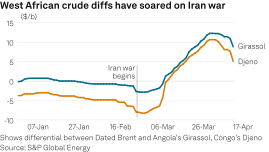
"Everyone rushed for West African crude in March," said one refining source with a Chinese state-run company, when its grades were trading at a steep discount to Dated Brent. "But now the differential flips."
"West African crudes have become plagues for us, but [it is] difficult to withdraw the buying," the refining source added.
The differential for Congo's medium sweet Djeno crude to Dated Brent shot up $18.60/b between Feb. 27 and April 7, from a steep discount to a hefty premium, according to assessments from Platts, part of S&P Global Energy.
Prior to the war, high shipping costs had put pressure on West African grades, but many vessels sailed to the Atlantic after the Strait of Hormuz was effectively shut.
In recent weeks, Chinese refiners have increasingly turned to more competitive crudes from Brazil and elsewhere, sources said.
CAS data shows that China took receipt of 1.303 million b/d of Brazilian crude in April, by far an all-time high.
Refiners re-offering
Relatively high prices for West African crudes -- Girassol was last assessed at a $8.81/b premium to Dated Brent on April 17 by Platts -- have led Chinese refiners to re-offer African cargoes in recent days, market sources said.
The largest customer for medium and heavy West African crudes, China tends to buy the region's barrels on long-term contracts, meaning they have been forced to enter the market to find alternative buyers.
Sources identified at least one cargo of West African crude re-sold by China to another Asian country, while Sinochem was also seen offering barrels of Angola's Dalia grade in the Platts MOC on April 13.
However, with some refiners unable to find new buyers for West African cargoes, they are forced to take receipt. Some have sought to offload cargoes that have almost reached China to peer refineries that are short on feedstock, with mixed success, sources said.
The diminished demand is also evident in the high availability of West African cargoes, according to loading programs obtained by Platts.
For Congo's Djeno grade, for instance, just two May-loading cargoes out of seven had been sold as of April 17, according to a West African crude trader, suggesting weaker buying than pre-war levels.
Not only is there plenty of availability from Brazil, Chinese refiners are still receiving some Iranian crude and Saudi barrels shipping via Yanbu on the Red Sea, thanks to the kingdom's vital East-West Pipeline. Russia's Urals grade also remains a key input for Chinese plants.
Although the Strait of Hormuz was shut again as of April 20, an eventual reopening -- like the temporary one announced by the US and Iran on April 17 -- could further dent demand for West African barrels.
"It is quiet out there," said a West Africa trader. "Feels like things have slowed down. Especially from China."
Another said that since the chaos in the immediate aftermath of the war, "it has flipped to a buyer's market."
