Refined Products, Crude Oil, Maritime & Shipping
April 17, 2026
Japan's ENEOS sets wholesale pricing to reflect broader crude procurement costs
Editor:
HIGHLIGHTS
To pass through spot/term procurement costs in wholesale
Refiners step up alternative crude procurements from US, others
May US crude arrival rises to 466,685 b/d from 76,705 b/d in April
Japan's largest refiner, ENEOS, has introduced a new pricing mechanism for its wholesale oil products, effective April 16, to better reflect broader crude procurement costs, the company said in a letter to its customers.
The letter, seen by Platts, part of S&P Global Energy, showed that the refiner revises its weekly wholesale prices to pass through spot/term contract procurement costs on a change in international crude oil prices, while adding several factors to the weekly prices once a month after April 16.
Those factors include a change in the price of the national reserves' crude oil, the ratio of the national reserves' crude oil to ENEOS' crude oil consumption, and changes in crude oil premiums, freight costs, and insurance premiums.
The refiner has already revised the wholesale prices for the week of April 16-22 to reflect the factors above and will reflect them only for a week over a change of the month, according to the letter.
An ENEOS spokesperson declined to comment on its change in wholesale pricing. However, the spokesperson said, "We appropriately reflect a cost in crude oil from sources including the national reserves and oil products from (undisclosed) sources on our wholesale prices, while we haven't changed our fundamental idea to set the wholesale prices on a comprehensive assessment based on a price change in crude oil as well as a cost to stabilize supply and prices in domestic and international oil product markets."
Bearing costs
The move by ENEOS comes to light as Japanese refiners are bearing the cost of the difference resulting from their change in crude benchmarks in their wholesale prices last month, following the government's switch of the fuel subsidy benchmark from the Nikkei Dubai price to ICE Brent crude futures.
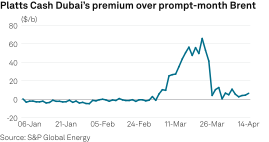
Japanese refiners appear to have incurred a cumulative loss of Yen 163.45 billion ($1.02 billion) in oil product sales over the four weeks to April 15, since the government restarted its gasoline subsidy program on March 19, as refiners shifted the benchmark for their wholesale oil product prices from Platts Dubai crude to ICE Brent futures, according to Platts calculations.
Due to significant delays in loading Middle Eastern crude and cargo arrivals, the refinery feedstock procurement team members are working to secure barrels from the Americas, West Africa, the Mediterranean, and Southeast Asia, according to an ENEOS feedstock inventory manager and a market analyst at Mitsui.
Japan has slightly reduced the share of Middle Eastern crude in 2025 from 95.4% in 2024, but the refining industry needs to make greater efforts to lower it below 90%, feedstock managers at three major Japanese refiners, including ENEOS and Cosmo Oil, told Platts over market discussions throughout March and April 1-17.
US crude
Japanese refiners have sharply increased their purchases of US crude since March -- likely to record highs -- as a replacement for lost Middle Eastern barrels due to the war.

At the start of April, traders estimated that Japanese refiners had purchased close to 14 VLCCs-worth of US crudes, spread across WTI Midland, West Texas Light, and Mars crudes, since the start of the war, though that number is likely to have grown further since then.
The cargoes are expected to arrive in Japan over May and June and were inked at prices linked to Platts Dubai and ICE Brent crude futures, trade sources said.
As of April 17, Japan is scheduled to receive a total of 20.152 million barrels, or 650,067 b/d, of crude in May, of which US barrels account for 14.467 million barrels, or 466,685 b/d, according to S&P Global Commodities at Sea data.
Non-US barrels arriving in May total 5.685 million barrels, including 682,344 barrels of Kazakhstan's CPC Blend crude, arriving at Kiire May 6, according to CAS data.
The May arrivals compare with 25.060 million barrels, or 835,344 b/d, of crude oil, of which US crude accounted for 2.301 million barrels, or 76,705 b/d, in April, according to CAS data.
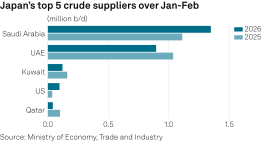
Japan imported 103,784 b/d, or 37.9 million barrels, of light sweet WTI Midland and West Texas Light crudes from the US in 2025, marking the highest annual shipment from the North American supplier, according to data from the Ministry of Trade, Industry and Economy.
In the first two months of 2026, Japan imported 96,025 b/d of US crude, nearly triple the 36,378 b/d purchased in the same period a year earlier, according to METI data.
Oil reserves
Meanwhile, Japan's Minister of Economy, Trade and Industry, Ryosei Akazawa, said on April 10 that Japan will release about 20 days' worth of crude oil from its national oil reserves after early May as its second measure to ensure a stable supply.
Japan has also extended its measure, allowing refiners and oil product importers to reduce the private-sector reserve level from the current 70 days to 55 days from April 16 until May 16, enabling a swift response by using the more flexible private reserves.
METI has informed Japanese refiners of its intention to use the Brent crude price as the basis for its next national oil reserve sales, a refiner source familiar with the matter said. METI declined to comment on the pricing basis for national oil reserve sales.
Japan's petroleum reserves were equivalent to 220 days of domestic consumption as of April 14, comprising 138 days in national oil reserves, 78 days in privately held reserves and four days in a joint crude oil storage program with oil-producing countries, according to the latest METI data released April 17.
