Crude Oil
April 15, 2026
Latin America set to benefit from Middle East crisis, but Mexico risks missing out

By Sheky Espejo
Editor:
HIGHLIGHTS
Latin America emerges as safe energy alternative
Brazil, Argentina lead supply diversification potential
Mexico risks losing out on investment boom
Latin America is poised to benefit from the ongoing Middle East energy crisis, with producers such as Brazil, Argentina and potentially Venezuela emerging as key alternatives to disrupted supply, while Mexico risks missing out due to structural constraints, according to observers and market participants.
The conflict, centered on disruptions to the Strait of Hormuz, which handles roughly 20% of global oil flows, has exposed vulnerabilities in the global energy system and accelerated a shift toward supply diversification, observers told Platts, part of S&P Global Energy.
"What we're observing in the Middle East is not just a disruption to oil and gas supply; it's a vulnerability in the global energy system," said Duncan Wood, CEO of Hurst International Consulting.
As geopolitical risks reshape trade flows, countries outside traditional chokepoints are becoming more attractive to buyers and investors, said Wood who is also a fellow at the Wilson Center.
"Any right-minded government is asking how to reduce exposure, increase autonomy, and diversify energy sources," he said.
"The Americas are in a very good position," said Tony Payan, an energy and geopolitics expert at Rice University's Baker Institute for Public Policy. "Those countries open to receiving investment will win."
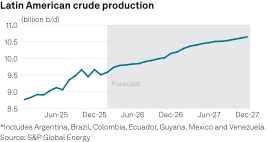
Brazil's deepwater reserves, Argentina's Vaca Muerta shale formation and emerging opportunities in Suriname position the region to capture incremental global demand in the short term, he said, adding that Bolivia's natural gas resources and Colombia's upstream potential could also attract renewed investor interest, albeit to a lesser extent.
Payan described Venezuela's potential reentry into global markets as one of the most consequential long-term developments.
"The opening of Venezuela would unleash significant oil volumes over time," he said. "Not immediately, but it would be very meaningful." However, he cautioned that rebuilding the country's oil sector will require massive capital outlays and years of work.
"Its infrastructure is old and poorly maintained. The first step is updating existing facilities, then investing in new ones. That will cost billions of dollars," he said. "It takes three to five years to develop a field."
"The crisis in the Middle East reinforces a trend toward diversifying supply away from producers exposed to geopolitical risks," said Diego Rivera Rivota, senior research associate at the Center on Global Energy Policy in New York. "Any producer outside the Strait of Hormuz becomes more attractive."
"Latin America is looking at global markets and asking, 'Why not us?'" Rivera said.
The industry is also seeing this opportunity.
"Energy security has become the most prominent element of the energy trilemma," said Carlos Ormachea, chairman of Tecpetrol, during Mexico's National Petroleum Convention on April 14. "Countries are prioritizing secure and diversified sources of supply."
Ormachea noted that recent global tensions have supported higher prices and improved the outlook for new developments.
"The current geopolitical situation is opening a window of opportunity," he said. "Prices in the coming years are likely to remain above the levels seen before this episode began."
Exploration and partnerships gain urgency
Executives also emphasized the importance of continued exploration and strategic alliances to meet future demand. Sylvia Maria Couto dos Anjos, director of exploration and production at Petrobras, underscored the need for strong national oil companies supported by private investment.
"Mexico needs a strong national oil company capable of forming partnerships with private companies," she said. "Public-private partnerships are the best option to develop resources."
She added that exploration remains essential to sustaining supply.
"If you stop exploring, production declines and reserves are not replaced," she said. "Mexico and Brazil must continue exploring."
Mexico lags despite resource potential
Despite its resource base, Mexico is less well positioned to capitalize on the shift due to a legal framework that obstructs investment, observers said.
"In Mexico, the problem is that nothing is guaranteed," Payan said, referring to frequent regulatory changes.
"There is no 'welcome' mat at the door of Mexico's energy sector. And the problem is that, for the industry, Mexico is not needed; there are opportunities elsewhere," he said.
Whether Mexico can answer that challenge and avoid being left behind will depend on its ability to translate resource potential into production at a time when global markets are actively seeking alternatives.
