Crude Oil, Refined Products
April 15, 2026
First oil tankers cross Hormuz since US blockade on Iranian ports
Editor:
HIGHLIGHTS
Two VLCCs, one MR cross Hormuz into Persian Gulf
US says six ships turned back in Gulf of Oman
Maritime traffic collapses during US-Iran war
Three oil tankers have transited the Strait of Hormuz into the Persian Gulf since April 14, according to shipping data, marking the first tankers to traverse the key waterway since a US blockade on Iran's ports came into force.
The Alicia and Agios Fanourios I VLCCs and the MR product tanker Peace Gulf transited Hormuz heading west on April 14 and April 15, respectively, with the Agios Fanourios I headed for Iraq's major Barash oil terminal, and the Peace Gulf for the UAE's Hamriyah, according to S&P Global Commodities at Sea.
All tankers used Iran's designated alternative corridor for Hormuz transits, a northerly route closer to the Iranian coast, with ships coordinating passage with Iranian authorities.
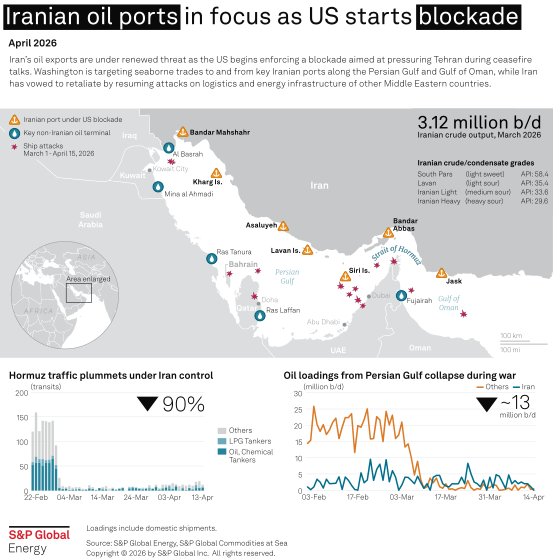
The US blockade on Iranian ports came into force April 13 at 1400 GMT, aiming to halt vessels entering or leaving Iranian ports while allowing passage through the Strait of Hormuz for non-Iranian destinations.
US Central Command said early April 15 that its blockade of Iranian ports has been "fully implemented" by US forces.
"An estimated 90% of Iran's economy is fueled by international trade by sea. In less than 36 hours since the blockade was implemented, US forces have completely halted economic trade going into and out of Iran by sea," CENTCOM Commander Brad Cooper said on X.
Enforcement in Gulf of Oman
In a research note, Dryad Global said the US is seeking to disrupt Iran's oil exports while preserving freedom of navigation for ships sailing to other Persian Gulf states.
"Early indicators suggest immediate market and routing effects, with some vessels already adjusting behavior," the security consultancy said.
Aside from the two VLCCs, CAS data shows the sanctioned chemical tanker Rich Starry exited Hormuz following the blockade' implementation. But the Handysize, laden with 35,000 metric tons of clean products, made a U-turn in the Gulf of Oman and has returned to the Persian Gulf.
The sanctioned Handysize chemical tanker Elpis, which had previously called at Iran's Bushehr port, sailed through Hormuz in the Gulf of Oman less than an hour before the blockade. The ship also turned back, according to CAS.
CENTCOM said US forces turned back nine merchant ships during the first two days of the blockade, at least six of them in the Gulf of Oman, but declined to comment on any enforcement within the Persian Gulf. Semi-official Tasnim news agency said three Iranian ships -- including the Alicia, also sanctioned -- sailed through Hormuz without being challenged.
A total of 18 vessels crossed the strait on April 14, including seven sectioned ships, CAS analysts said in an April 15 report. This compares with 12 on the prior day and 135 in February.
Following US and Israeli air strikes on Feb. 28, Iran has seized control of Hormuz and only allowed access to its own tankers and a small number of ships that are mostly linked to Asian countries.
The country's total crude and petroleum product loadings, including those for domestic shipments, fell from 3.22 million b/d in February to 2.56 million b/d between March 1 and April 14, according to CAS. Loadings from other Middle Eastern producers' Persian Gulf ports plummeted to 3.19 million b/d from 19.7 b/d in the same period.