NGLs, Natural Gas
April 09, 2026
Mexico eyes unconventional gas push, but faces challenges

By Sheky Espejo
Editor:
HIGHLIGHTS
Mexico targets 8 Bcf/d gas output by 2035
Strategy may require $19 billion, private partners
Infrastructure limits constrain gas supply
After months of analysis, Mexico has unveiled its intentions to exploit its vast untapped gas resources, a move that would require the state oil and gas company Pemex to venture into unconventional deposits using fracking technology, analysts told S&P Global Energy.
Officials from Pemex and the energy ministry on April 8 outlined the goals of the government to raise the domestic production from 2.3 Bcf/d at the end of 2025 to roughly 8 Bcf/d by 2035, to radically reduce the dependency on imports.
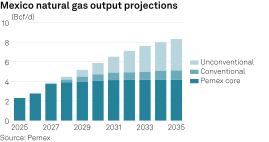
However, industry observers say the government's ambitious targets raise questions about feasibility and execution.
"The figures being presented are quite optimistic," said Alexis Morales, a gas analyst for Mexico at S&P Global Energy.
Currently, non-nitrogen gas production averages 3.7 Bcf/d, while available gas to market stands at 2.2 Bcf/d, he said, noting that exploration in Mexico usually takes between four and five years, plus one more year for drilling.
"Reaching the goal in such short time seems challenging," he said.
Analysts welcomed the acknowledgment of the need to develop unconventional resources, viewing it as a significant paradigm shift.
However, the details of how Pemex intends to increase its base production remain unknown, as well as how it plans to achieve such rapid growth in unconventional resources, said Rodrigo Rosas, an analyst at Wood Mackenzie.
"Almost doubling current production is extremely challenging," Rosas said, noting that Mexico is effectively aiming to reach the output of Argentina's Vaca Muerta shale play in half the time.
Despite the strategic rationale, Pemex's financial constraints are expected to limit its ability to independently develop unconventional resources.
"Pemex's financial situation suggests that the development of unconventional fields would need to materialize in partnership with the private sector," Rosas said.
Wood Mackenzie estimates that the government's strategy could demand as much as $19 billion, making private-sector participation essential.
Yet, due to Mexico's existing contractual framework, it may struggle to attract international operators, he said.
"Mexico must offer legal certainty and attractive conditions, particularly regarding government take compared with peer countries," the analyst added. "The framework must be a win-win."
Infrastructure bottlenecks and market constraints
Even if upstream production increases, infrastructure limitations could constrain the availability of marketable gas.
Although gross output has increased slightly due to higher production of non-associated gas, marketed volumes have continued to decline.
"Marketed gas production continues to fall because of insufficient infrastructure and limited optimization of processing plants," Morales said. "This has led to an increase in flaring."
As a result, boosting production alone may not translate into meaningful supply gains.
"It serves little purpose to increase gross production if its utilization continues to decline," he added.
Long-term energy security at stake
Mexico currently imports around 80% of its natural gas from Texas, exposing the country to price volatility and supply risks. Analysts say this dependence underscores the urgency of developing domestic resources.
"Mexico must consider that Texas prices, the benchmark, will not remain low forever," Rosas said. "Upward pressure on Henry Hub will raise the cost of imports."
"The government will need to assess the cost of energy security," he added. "Mexico should already be thinking about the long term, the next 35 years."
