Crude Oil, Maritime & Shipping, Wet Freight
April 09, 2026
G7 crude tankers withdraw from Russia with Urals rising above price cap

By Max Lin
Editor:
HIGHLIGHTS
G7 share in Russia falls to 10-month low
US waiver allows shadow fleet to trade
UK plans new clampdown on Russian tankers
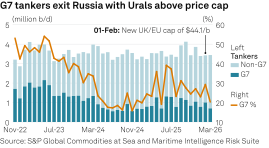
G7-linked crude tankers started to withdraw from Russia in March, with rising crude prices limiting their trading opportunities within the price cap.
Tankers flagged, owned or operated by companies based in G7 countries and their allies, or insured by Western protection and indemnity clubs, lifted 20.3% of Russia's crude exports of 3.4 million b/d last month, according to data from S&P Global Commodities at Sea and Maritime Intelligence Risk Suite.
This was down from 29.2% in February and the lowest in 10 months.
Currently, the EU, UK and Canada set the price threshold for tanker firms and insurers to facilitate Russian crude exports at $44.10/b. Japan's price cap is at $47.60/b, and the US at $60/b.
After the US-Iran war broke out on Feb. 28, international oil prices have surged on the near absence of supply from Persian Gulf producers with Iran limiting ship traffic via the Strait of Hormuz.
The monthly average price for Urals, Russia's flagship crude, on a free-no-board Primorsk basis, jumped from $39.169/b in February to $71.254 last month – the highest monthly reading since July 2024 – according to Platts assessments. It was assessed at $89.025/b on April 8.
Platts is part of S&P Global Energy.
On March 12, the US issued a 30-day waiver for Russian oil on the water that allow shipments to all buyers regardless of the producers' and ships' sanctions statuses in a bid to increase supplies.
But the EU didn't adopt a similar measure. The CAS and MIRS data shows tanker operators in Greece, Europe's largest shipowning nation, were responsible for loading 379,000 b/d of Russia crude in March, down from 551,000 b/d in February and the lowest since May 2025.
New clampdown
The US waiver has allowed shadow fleet tankers, which make up the non-G7 fleet for sanctioned trades, to have more chances to engage in seaborne trades with less legal risks.
Last month, non-G7 tankers lifted 27.9 million barrels of Russian crude for shipments to China and 14.7 million barrels to India, according to CAS and MIRS. Both monthly figures were the highest in three months.
On March 31, a crude tanker arrived in Cuba on March 31 to deliver 732,400 barrels of Urals crude, according to CAS. US President Donald Trump has indicated he would not oppose fuel shipments to Cuba, which faces a US economic embargo.
But the UK in March authorized British forces to interdict sanctioned tankers in UK waters, vowing to undermine Russia's war chest against Ukraine.
The amount of Russian-flagged oil tankers crossed through the Strait of Dover increased by 26.1% on the month in March, with Russia seeking to increase exports at high prices, according to S&P Global Market Intelligence research.
"Since the announcement, multiple tankers assessed to be involved in Russian crude transport have altered course or avoided UK waters entirely, with several repositioning in the North Sea rather than continuing southbound transit," consultancy Ambrey said in a note.
The Daily Telegraph reported a Russian frigate escorted two shadow fleet tankers through the English Channel on April 8. UK Defence Secretary John Healey said in a press conference that the development shows UK actions have an impact on Russian oil trades, according to the Guardian.
The UK Ministry of Defence did not respond to an email seeking further comments.
