Crude Oil
April 08, 2026
India spots opportunity in Venezuelan crude as Hormuz crisis squeezes supplies
HIGHLIGHTS
Venezuelan crude flows to rise in April, May: CAS
Heavier grades suit some complex refineries only
Russian oil flows rise despite higher prices
India has turned to Venezuelan crude for near-term cargoes to fill part of the vacuum created by the disruption of supplies from the Middle East, but volumes from the South American supplier may not increase significantly as those heavier grades can only be used by some complex refineries, trade sources and analysts said April 8.
Amid significant disruptions to flows following the Strait of Hormuz closure, S&P Global Commodities at Sea data showed that a total of 12.4 million barrels of Venezuela-origin crude are in transit to be discharged at India's port of Sikka in April 2026, with an additional 5.7 million barrels already scheduled for May arrivals, highlighting a sharp near-term increase in flows.
"Further upside remains capped by refinery configuration. Heavier Venezuelan grades such as Merey-16 fit best in India's most complex refineries. In the near term, the ongoing Middle East crude supply disruption adds diversification pressure on Indian refiners. However, this is also balanced against a 30-day US waiver for Russian oil as an alternative feedstock. That could cap additional Venezuelan growth if Russian barrels clear more competitively on delivered economics," said Benjamin Tang, head of liquid bulk at CAS.
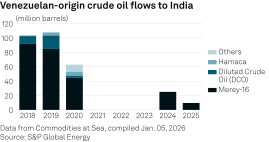
"For complex refining systems like India, Venezuelan heavy crude is not an incremental supply. It is optionality," said B. Anand, industry expert and former CEO of Nayara Energy.
Alternative to Middle Eastern flows
Venezuelan grades like Merey-16 will face direct competition from alternatives such as Iraqi Basrah Heavy and Canadian Cold Lake, Tang said.
"Venezuelan crude is a great opportunity for refiners, like Reliance Industries Ltd. They have great blending facilities and complex operations, and they can yield good margins by processing those heavier grades," said DLN Sastri, former director of refining at the Federation of Indian Petroleum Industry. "Even some state refining units, like MRPL and the Paradip Refinery of Indian Oil Corp., can process Venezuelan grades."
Average hydrocarbon production by Venezuelan state oil company PDVSA and its foreign partners, including those with production and participation contracts, increased to 1.085 million b/d in March from 1.06 million b/d in February, according to preliminary data from the Ministry of Hydrocarbons reviewed by Platts. Production in the Orinoco Belt, Venezuela's main oil-producing region, rose to 565,000 b/d in March from 560,000 b/d reported in February, according to the preliminary data.
"Venezuelan production is stabilizing precisely when refiners need alternatives to supply concentration and geopolitical overhang. Its reserves are well known. What matters here is the timing," Anand said.
Russian flows rise, at higher prices
Indian refiners have also stepped up purchases of Russian cargoes after a 30-day US waiver permitted the sale and delivery of sanctioned Russian oil already on ships. According to CAS data, Indian imports of Russian crude rose to 1.787 million b/d in March, from 1.073 million b/d in February and 1.216 million b/d in January.
The waiver on Russian crude announced by the US Department of the Treasury on March 5 came as Middle Eastern oil producers and exporters continued to face severe restrictions on shipping through the Strait of Hormuz -- through which about 20 million barrels/day of crude and oil products passed in 2025 -- creating an opportunity for India to secure more crude cargoes to address the immediate shortfall.
"Russian volumes have risen. The concern over the past month has been how to secure supplies, irrespective of the high price. Indian refiners managed to get the Russian volumes and they picked them up," Sastri said.
On March 17, Platts assessed Urals DAP India above forward Dated Brent for the first time since records began in 2023, as the Russian grade strengthened to a $1.7/b premium against the international oil benchmark. Over April 7, the premium was assessed at $8.30/b, marking new all-time highs.
The widening price differentials reflect a major shift away from the significant discounts on Russian fuel before the US launched its first strikes against Iran. On Feb. 27, Urals DAP India was assessed $11.99/b below Brent and had historically traded at least $1.8/b lesser than the benchmark even when the spread was at its narrowest in July 2025.
