Crude Oil, Refined Products, Diesel-Gasoil, Gasoline
April 07, 2026
Iran war-related oil shut-ins to rise to 9.1 million b/d in April: US EIA

By Kate Winston
Editor:
HIGHLIGHTS
Brent crude to peak at $115/barrel in Q2
US gasoline to hit $4.30/gal, diesel to top $5.80/gal
The US Energy Information Administration estimates that oil production shut-ins linked to the US-Israel war with Iran will rise to 9.1 million b/d in April, before falling to 6.7 million b/d in May as the conflict ends and traffic through the Strait of Hormuz gradually resumes.
"Just as we had never before seen the strait close, we've never seen it reopen," EIA Administrator Tristan Abbey said in an April 7 press release. "What exactly that looks like remains to be seen. Full restoration of flows will take months."
The EIA's April Short-Term Energy Outlook estimates that Iraq, Saudi Arabia, Kuwait, UAE, Qatar and Bahrain have collectively shut in 7.5 million b/d of crude production in March.
Production disruptions imply a global inventory draw of 5.1 million b/d in the second quarter of 2026, the EIA said.
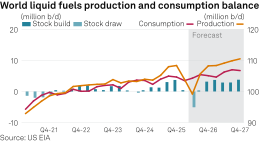
The US and Israel have been at war with Iran since Feb. 28, which led to Iran effectively shutting the Strait of Hormuz. Since 20% of the world's oil and LNG flows through the strait, the effective closure has led to regional oil production shut-ins.
Nine vessels transited the strait on April 6, down from 13 on April 5, based on S&P Global Commodities at Sea tracking. No crude or refined product tankers were observed transiting on April 6, compared to the eight oil tankers that transited on April 5, CAS analysts said in an April 7 report.
US President Donald Trump has given Iran an ultimatum to reach an agreement with the US -- including reopening the Strait of Hormuz -- by April 7 at 8 pm ET, or face intensified military strikes.
"A whole civilization will die tonight, never to be brought back again. I don't want that to happen, but it probably will," Trump said in a Truth Social post.
The EIA raised its 2026 Brent oil price outlook to $96/barrel, up from $79/b a month ago, based on the assumption that the war in Iran will not persist past April.
The EIA expects the Brent crude spot price to peak in the second quarter of 2026 at $115/b before slipping as production shut-ins ease. The outlook forecasts that Brent prices will fall below $90/b in the fourth quarter of 2026 and average $76/b in 2027.
"We maintain a risk premium on crude oil prices throughout the forecast period as we expect uncertainty around future supply disruptions to keep prices above pre-conflict levels," the EIA press release said.
The EIA forecasts retail gasoline prices to peak at a monthly average of close to $4.30/gal in April and average more than $3.70/gal this year.
"Diesel prices peak at more than $5.80/gal in April and average $4.80/gal in 2026," the EIA said.
The EIA has revised its assumptions for global oil demand based on reports of government efforts to reduce fuel use, fuel shortages and the curtailing of refined oil product exports. Most demand reductions are assumed to occur in Asia, the EIA said.
"As a result, we now assume that global oil demand growth will average 0.6 million b/d in 2026, down from an average of 1.2 million b/d in last month's STEO," the EIA said. "We assume oil demand will rebound next year once supply flows return later in 2026, with oil demand growing by 1.6 million b/d in 2027 to 106.2 million b/d."
