Maritime & Shipping, Refined Products, Wet Freight
March 30, 2026
Trans-Atlantic clean tanker rates surge on US export rise, Jones Act waiver
By Thomas Washington and Marina Ledakis
Editor:
HIGHLIGHTS
Jones Act waiver tightens vessel availability
US Gulf exports to Europe surge amid ME halt
USGC-UKC now fronthaul flow
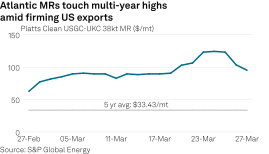
Clean tanker rates for Europe-bound cargoes from the US Gulf surged to multiyear highs in March, driven by stronger US refined product exports and tightening vessel availability, market analysts said.
Platts assessed the rate to carry a 38,000 metric ton clean cargo from the US Gulf Coast to UKC at $95.12/mt on March 27, after reaching $124.21/mt on March 24 -- 185% above the five-year average.
Global product flows have shifted after conflict-related disruptions reduced Middle East and Asian clean exports, while Atlantic Basin refiners increased runs to capitalize on stronger margins. Additionally, a shift in legislation in the US has absorbed more tonnage in its territorial waters.
"Because of the loss of [Middle East Gulf] refined product exports and lower Asian clean exports (as refineries there are lowering run rates and either banning or curbing exports), stronger refining margins in the Atlantic are allowing for increased exports," Claire Grierson, head of tanker research at shipbroker Simpson, Spence & Young, told Platts, part of S&P Global Energy, March 27.
MR rates have hit record levels, in part because the US has lifted product exports to Europe and other destinations, and because of the US Jones Act waiver, Grierson said.
The supply from the US plays a fundamental role in ensuring Europe's energy needs are met, Kevin Zhao, a shipping analyst at S&P Global Energy CERA, said March 30. "An increase in US Gulf volume has been observed, leading to a higher demand for shipping on the US Gulf-Transatlantic route," he said.
With the halt in supply from the Persian Gulf, Europe also needs to rely on intra-regional trades to bridge the supply gap. This situation will also keep the MR fleet busy, Zhao added.
Jones Act waiver
The US government issued a limited waiver of the Jones Act on March 18 to counter rising oil prices and cargo disruptions. Section 20 of the Merchant Marine Act of 1920, commonly known as the Jones Act, mandates the use of US made, owned and crewed ships for the transportation of cargo between domestic ports.
The US Gulf has already seen foreign-flagged vessels fixed for intra-US movements, intensifying competition for available tonnage. Unusual trade routes have emerged, including US Gulf-to-Asia gasoline shipments that have further boosted market levels, representing the trade shifts occurring in the wake of the Iranian conflict, Grierson said.
The Jones Act waiver should theoretically slow UKC-US Atlantic Coast trade, though firm evidence of that impact has yet to emerge, Svetlana Lobaciova, principal analyst at Gibson, told Platts separately March 27.
In the US, enquiry remains strong across the board, with the US Gulf positioned to offer incremental barrels into Europe going forward, though facing competition from other import regions. Some export barrels from the USGC will be diverted into the domestic market for the US West Coast and PADD 1 regions, Lobaciova said.
Shifting route relationships
More than half of the refineries in the world are directly exposed to the Middle East conflict, either due to proximity and physical vulnerability, affecting 12 million b/d of capacity, or due to the processing of crude exported via the Strait of Hormuz, which affects an additional 42 million b/d of capacity, analysts at CERA said March 12.
More than 4 million b/d of refined product exports through the Strait of Hormuz have been completely halted, leaving a gap of jet/kerosene and distillate in Europe and Africa to the tune of nearly 1 million b/d, and a crude, fuel oil and petrochemical feedstock crunch in Asia, the analysts said.
Amid this, the US exported 371,400 b/d of refined products to Northwest Europe in 2025; this was higher in March 2026 at 429,200 b/d, data from S&P Global Commodities at Sea showed March 28. This has proved a one-way increase; Northwest Europe exported 198,000 b/d to the US in 2025 and 48,000 b/d in March.
There has been reduced transatlantic UKC-US Atlantic Coast trade, on lower USAC gasoline import needs. Fewer ships are ballasting from the USAC to the USGC, meaning the US Gulf is reliant on vessels with longer ballasting times to lift cargoes, Grierson said.
The traditional relationship between the USGC-UKC and UKC-USAC routes has reversed, with USGC-UKC now functioning as the "fronthaul trade," Grierson said. Reduced West African import needs on greater refinery capacity have also curbed European trade flows into the Atlantic, she said.
Nigerian refiner Dangote has lifted exports in March, adding to available Atlantic Basin supply, Grierson said.
