Refined Products, Gasoline, Jet Fuel
March 24, 2026
CERAWEEK: Shell CEO warns road fuel crunch to follow jet squeeze over Hormuz blockade
Editor:
HIGHLIGHTS
Diesel, gasoline supplies at risk of further tightness: Sawan
Market pressures set to coincide with driving season demand
National stockpiling risks amplifying refined product squeeze
Shell's chief executive warned March 24 that tightening global jet fuel supplies could usher in a broader refined products supply crunch during peak summer driving season in the Northern Hemisphere if the Middle East crisis continues to hit oil flows.
"Jet fuel is already being impacted. Diesel will be next to come after that will be gasoline," Wael Sawan told the CERAWeek by S&P Global conference in Houston. "Of course, you're moving into summer season, which is typically driving season in the northern hemisphere."
Global jet fuel prices have been some of the hardest hit by almost a month of war in the Middle East, which has shut off roughly 14 million b/d of oil products and mostly medium sour crude, according to analysts at S&P Global Energy CERA. In Europe, jet cargo prices more than doubled to hit an all-time high on March 19, while US Gulf Coast prices hit a premium of 30 cent/gal on March 23, up from a 12 cent/gal discount on Feb 27.
Nevertheless, Sawan urged analysts and policymakers not to fixate on any single fuel type, cautioning that the full impact would be felt across the entire product slate. The product crunch, the CEO said, stems from physical supply chain disruptions that originated in South Asia and have since rippled through Southeast and Northeast Asia, with Europe in the crosshairs should the conflict drag on.
"It's a ripple effect," he said, adding that Shell was actively engaging governments on the range of policy tools at their disposal. "We are trying to work with governments to alert them to the various levers they need to pull, including on the demand side, including what they need to do around storage, what they need to do around purchasing stock."
He stressed that the core problem was one of physical commodity flows rather than paper markets, and described a need to clear blockages across shipping, storage, and production infrastructure simultaneously.
"Our customers need the molecules, need the electrons, and our ability to be able to unplug arteries — including shipping arteries, storage arteries, production arteries — all of those are the elements we need to be able to work to ensure that those supplies do get through," he said.
More than half of the world's refineries, with some 12 million b/d of capacity, are directly exposed to the conflict, either due to proximity or dependence on Middle Eastern crudes, according to analysts at S&P Global Energy CERA. Recent infrastructure damage, including hits to refineries, terminals and port infrastructure, could also threaten the likelihood of a rapid rebound in flows.
Stockpiling risks
Sawan also flagged a secondary risk that could amplify the underlying supply tightness: a behavioral shift toward hoarding by both governments and market participants. Protective stockpiling, he warned, risks turning a manageable supply strain into a more severe dislocation.
While the US has so far ruled out a crude export ban in response to the crisis, China has banned its shipments of refined products, and European countries, including Hungary, Slovakia and Romania, have also shut in supplies. On the supply side, France and the Czech Republic have pushed to postpone refinery maintenance and boost domestic production.
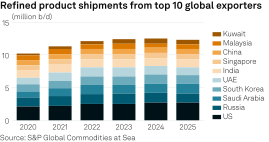
According to S&P Global Commodities at Sea data, the US was the world's largest refined products exporter in 2025, accounting for 14% of all seaborne flows and almost double those of Saudi Arabia, the number-two supplier. However, exports have dovetailed in March. In the month to date USGC jet fuel exports have averaged roughly 66,000 b/d, less than half the previous full-year average, while gasoline exports have fallen by almost 30%, CAS data shows.
Shell holds stakes in seven refineries globally -- four in Europe, two in Canada and one in the US. The 404,000 b/d Pernis refinery in Rotterdam is the largest in its portfolio, followed by the 231,827 b/d Norco plant near New Orleans.
According to a report by UK bank HSBC on March 20 Shell is also among the energy majors with a significant proportion of its upstream portfolio in the Middle East Gulf, with an estimated exposure of roughly 15%. Shell was not available for comment.
