Crude Oil
March 23, 2026
CERAWEEK: US shale oil production seen to plateau, Chevron CEO says

By Ashok Dutta
Editor:
HIGHLIGHTS
Verdict still out on whether US will increase production
Chevron to hold Permian output at 1 million b/d
US producers looking overseas: Hamm Institute
Shale oil production in the US has "probably" plateaued over the past six to 12 months, depending on the environment coming out of the current Middle East crisis, Chevron Corp. CEO Mike Wirth said March 23.
"The demand for gas will continue to grow, and the high oil prices could re-stimulate some growth in crude oil production or not," Wirth said at the CERAWeek by S&P Global conference. "We will have to see how it plays out."
Wirth did not provide details on the anticipated plateau in crude oil output, but S&P Global Energy CERA said in its March analysis that US crude production stumbled at year-end 2025 and was temporarily hobbled by severe winter weather in January.
However, it estimates US output grew by 365,000 b/d in 2025 despite lower oil prices. Even with softer WTI prices expected in 2026, efficiency gains and offshore growth keep the outlook resilient: Lower 48 production is expected to decline only marginally, while Gulf of Mexico and Alaska output rises.
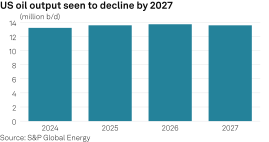
Eventually, however, CERA expects sustained lower prices in 2026 to lead to a 150,000 b/d decline in US production in 2027, the analysis said.
US crude oil output is forecast to decrease to 13.597 million b/d in 2027, from an anticipated 13.747 million b/d in the current year, compared with 13.599 million b/d in 2025 and 13.235 million b/d in 2024, the CERA analysis said.
The Permian Basin in south Texas, including the two prolific areas of Delaware and Midland, has been an engine of growth in the past 15 years, with output from that basin alone accounting for nearly 50% of the US' total output, the CERA analysis said.
Major producers in the Permian include Chevron, ExxonMobil Corp., ConocoPhillips, Diamondback Energy, EOG Resources, Devon Energy, Permian Resources, and Occidental, among others.
"For the last decade, we said we intended to get Permian to some scale, and we would move toward plateau production to generate free cash," Wirth said, pointing out that, for its part, Chevron is targeting to hold production at 1 million b/d.
"We are using technology now to improve recoveries and are doing pilots in the field [using new technology] this year and next year. The Permian continues to be a tremendous asset for our company," he said. "We live in an era where the tools and capabilities of technology have never been better than they are today."
Chevron will see incremental use of its chemical surfactants at its Permian assets in 2026, CFO Eimear Bonner said on fourth-quarter 2025 earnings webcast in late January.
"We've increased the treatments from about 40% of the new wells being treated in H1 2025 to almost 85% to be treated this year, and we're striving to hit 100% in 2027," Bonner said then. "What we've also learned is we can apply these technologies not only to the new wells, but also to existing wells."
Demand-driven versus supply-driven
"There are two ways to define plateau: either demand or supply driven," Executive Director with the Hamm Institute for American Energy Ann Bluntzer told S&P Global Energy Platts on the sidelines of the CERAWeek conference. "Different producers are making decisions to act independently, possibly not continue drilling and exploring, and a lot of that is based on demand. Some of those reserves are not as profitable as they once were, and that creates a scenario where a plateau can be financially driven."
Shale oil development in the US has been at the center of the US' energy policy. However, producers still have a runway for development, Bluntzer said, adding: "Those [players] who are drilling and exploring are clearly in this country are looking overseas, and that should be an indicator of the trend. The target is to get more recoveries from existing assets."
Houston-based EOG Resources has existing assets in the UAE and Bahrain, focused on developing tight shale oil and gas assets, according to the company's website.
