Crude Oil, Refined Products
March 20, 2026
Israel's Haifa refinery confirms damage to 'essential' infrastructure
By Kelly Norways and Elza Turner
Editor:
HIGHLIGHTS
Third-party infrastructure offline, electrical systems damaged
External equipment could take 'a few days' to restart
Most production facilities still operating, owner says
Israel's largest refinery, Haifa, has confirmed it was affected by an Iranian missile strike that hit infrastructure "essential to its operations" on March 20, and is in the process of restoring production.
A statement from Bazan Group, which operates the 197,000 barrels/day Haifa refinery, said the facility was damaged by an attack on March 19, which hit its electricity infrastructure and an area near one of its administrative buildings.
Additionally, "essential" equipment located outside the complex and owned by a third-party operator was taken offline, it said, without providing further details on the infrastructure hit.
The external damage was discovered overnight after attacks across northern Israel, the Bazan statement said, adding that returning the equipment to normal operations could take "a few days".
Nevertheless, Bazan Group said most of its own production facilities are still operating, with the remainder in the process of being restarted.
Traders had previously expected minimal disruption to the refinery on Israel's northern coast after the country's energy minister reported "no significant damage" to local infrastructure after the attacks.
Haifa is one of just two refineries operating in Israel, and is responsible for roughly 64% of the country's crude processing capacity. During the 12-day war in June 2025, it was attacked and fully taken offline.
At the time, the refinery was forced to suspend operations after drone attacks triggered a power cut and damaged nearby pipeline infrastructure. As a result, it was left operating below capacity for months before it could return to normal operations.
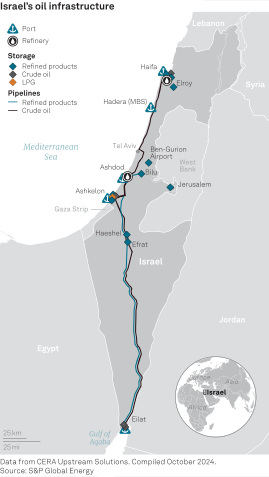
According to a report from Bazan Group published on Dec. 12, the site was running with two of its three CDUs by the third quarter of 2025, leaving its January-September utilization rates 10 percentage points lower year over year.
Israel's second refinery, Ashdod, has a capacity of 110,000 b/d. Across the two facilities, the country produced roughly 280,000 b/d of refined products in 2025, contributing to a 70,000 b/d surplus, analysts at S&P Global Energy CERA estimate.
Last June, Israel's refined product imports spiked to almost 20,000 b/d, mostly from the US and Greece, but later normalized to 9,000 b/d over the full year. Fuel deliveries have been sluggish in 2026, with no arrivals recorded in January and February, and just 9,000 b/d delivered in March, according to S&P Global Commodities at Sea data.
The new drone incident makes Haifa the latest refinery target as Iranian attacks have broadened to hit more energy facilities from the Persian Gulf to the Mediterranean coast. A spate of recent attacks struck Qatar's Ras Laffan gas hub and QatarEnergy's Pearl GTL facility, as well as the UAE's Habshan gas infrastructure.
In the refining sector, drones sparked fires at Mina Abdullah and Mina al-Ahmadi facilities on March 19, and a separate incident was reported at Saudi Arabia's 402,000 b/d Samref refinery. Previously, Bahrain's Bapco refinery and Saudi Arabia's Ras Tanura have also been targets.
