Crude Oil, Refined Products, Maritime & Shipping, Diesel-Gasoil, Jet Fuel, LPG
March 19, 2026
FACTBOX: Volley of attacks on Gulf energy sites sends prices soaring
HIGHLIGHTS
Brent crude futures pass $118/b in early trading
Qatar LNG repairs may take three to five years
Hormuz traffic dips again as war escalates
Crude futures surged to fresh four-year highs on March 19 and the Brent-Dubai spread widened further as Iran launched a volley of missiles and drones at Gulf energy infrastructure, marking a significant new escalation in the Middle East war.
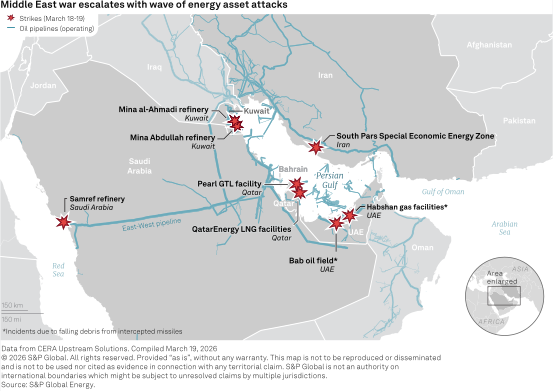
Following an Israeli strike on Iran's critical South Pars gas field on March 18, Tehran began striking a "hit list" of oil and gas fields, terminals and processing facilities in Qatar, the UAE, Kuwait and Saudi Arabia, including Qatar's Ras Laffan complex, home to the world's largest LNG export facility.
In a note, analysts from S&P Global Energy said the attack on Qatar "signals wider targeting of LNG infrastructure and creates significant uncertainty around the restart of Qatari output."
Meanwhile, Iranian foreign minister Abbas Araghchi wrote on social media platform X that Iran would deploy "zero restraint if our infrastructures are struck again."
Infrastructure
Major oil and gas facilities across the Gulf have sustained damage from missile and drone attacks, posing a long-term supply risk.
- A series of missiles struck Qatar's giant Ras Laffan gas hub, home to the world's largest LNG export terminal, with state-run QatarEnergy saying the attacks had caused "sizeable fires and extensive further damage."
- QatarEnergy's Pearl GTL facility, the world's largest gas-to-liquids plant, suffered "extensive damage", QatarEnergy said, while Shell, the plant's operator, said "the fire was quickly put out and Pearl is now in a safe state."
- Qatar's energy minister Saad al-Kaabi told Reuters March 19 that it could take three to five years to repair the damage to the country's LNG facilities, causing long term supply shortages and billions in lost revenue.
- Operations at the UAE's Habshan gas facilities in Abu Dhabi were suspended following incidents caused by falling debris from intercepted missiles, according to the official Abu Dhabi Media Office.
- A drone fell on Saudi Arabia's 402,000 b/d Samref refinery near the Red Sea port of Yanbu, a joint venture between Aramco and ExxonMobil, the country's defense ministry said on X.
- The Saudi Press Agency quoted a military spokesperson saying authorities had shot down a ballistic missile over Yanbu, the kingdom's sole export terminal outside the Persian Gulf on which it now relies to export its crude.
- Kuwait's Mina Abdullah and Mina al-Ahmadi refineries were hit with drones, causing fires that have now been extinguished, Kuwait Petroleum Company said in a statement, marking the second attack on the 330,000 b/d Mina al-Ahmadi plant since war broke out Feb. 28.
- A Qatar-flagged tug vessel off the coast of Ras Laffan was hit by debris as air defense systems knocked down an incoming airstrike, shipping agencies said.
- There have been 22 incidents affecting vessels operating in and around the Persian Gulf, Strait of Hormuz, and the Gulf of Oman since the war began, according to data from UKMTO.
Prices
Crude, refined product and gas prices have surged again to multiyear highs.
- The Platts Dubai crude benchmark was assessed at a record high of $166.80/b on March 19, up 7% day over day. It was around $70/b pre-war.
- Platts, part of S&P Global Energy, assessed Dated Brent at $112.53/b on March 18, up 9% day over day and the highest since July 2022, following the South Pars attack. US Gulf Coast crude was assessed at $101.64/b, up 2% day-over-day.
- Brent futures surged past $118/b in early European trading on March 19, before softening. Front-month ICE Brent was trading at $109.64/b as of 1605 GMT, up 2% on the previous close.
- NYMEX WTI futures were up 2% on the previous close to $98.46/b at 1606 GMT.
- The Brent-Dubai crude spread widened to a new four-year high of $13.06/b on March 19.
- Platts assessed Northwest European jet fuel at a new record high of $1,693/mt on March 18, up 4% from March 17.
- Ultra-low sulfur diesel in Amsterdam-Rotterdam-Antwerp surged 10% day over day to $1,355/mt on March 18, yet another four-year high.
- The VLCC index for non-scrubber-fitted non-eco ships ended March 18 at $318,821/day, down 4% from the previous day, having fallen roughly $200,000/day since March 4.
- European natural gas prices surged 30% early March 19, with the April Dutch TTF contract trading at Eur72/MWh, before subsequently easing into the mid-to-high Eur60s/MWh.
- Italy said it would cut taxes on diesel, gasoline, and LPG for 20 days starting March 19 to contain price spikes related to the Middle East war.
Trade flows
Importers are scrambling to diversify their energy supplies, with the pivotal Strait of Hormuz still effectively shut.
- Vessel transits through the Strait of Hormuz dropped again March 18, as Iranian parliamentarians said they were considering a levy on ships passing through the chokepoint.
- Just two vessels transited Hormuz on March 18, down from five on March 17, according to S&P Global Commodities at Sea data. Prior to the war, around 140 tankers would cross the strait daily.
- Exports of Saudi crude from Yanbu, the kingdom's sole loading terminal outside the Persian Gulf, have surged to 5.12 million b/d this week, according to CAS data. Loadings have averaged 2.83 million b/d in March, compared to 814,000 b/d in February.
- US Treasury secretary Scott Bessent said Washington was considering lifting sanctions on Iranian crude held in tankers. "In the coming days, we may "unsanction" the Iranian oil that's on the water. It's about 140 million barrels," Bessent told Fox Business March 19.
- India is stepping up LPG diversification efforts, entering the market for US LPG amid concerns about cooking fuel availability, CAS data shows. India previously imported 60% of its LPG from the Gulf region.
- Sinopec Shanghai Petrochemical is looking to urgently diversify its feedstock sources and reduce its Middle East dependence, a company executive said during its annual results briefing March 19.
- In a joint statement March 19, the leaders of the UK, France, Germany, Italy, the Netherlands and Japan expressed "our readiness to contribute to appropriate efforts to ensure safe passage through the Strait." They added: "We welcome the commitment of nations who are engaging in preparatory planning."
