Crude Oil, Maritime & Shipping, Wet Freight
March 17, 2026
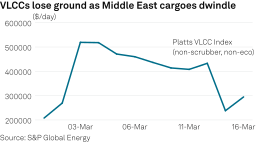
VLCC rates face downward pressure as tankers flee Gulf crisis
HIGHLIGHTS
Persian Gulf crude loadings sink to 4 million b/d
VLCC rates tumble from record high
Vessel repositioning bearish for Atlantic freight markets
The disruption to crude oil flows from the Persian Gulf is weighing on tanker freight rates, after an initial spike, as vessels reposition away from the Middle East and threaten to create an oversupply of ships chasing cargoes in the Atlantic Basin.
Crude loadings around the Persian Gulf plummeted to 4 million b/d in the week starting March 9, down from 19 million b/d in February and 17.5 million b/d in 2025, according to S&P Global Commodities at Sea data March 17. The collapse in activity comes as attacks on oil infrastructure force Gulf countries to shut production and refining capacity.
Strait of Hormuz transits numbered four on March 16, down from an average of 135/day through February 2026, CAS data showed.
"Due to the reduced availability of crude oil in the Persian Gulf, many are eagerly ballasting to the Atlantic, where they aim to secure crude from this major production region outside the Persian Gulf," Kevin Zhao, a shipping analyst at S&P Global CERA, said March 17.
The Persian Gulf accounted for over 60% of VLCC loadings in 2025, according to CAS data.
The Platts VLCC index for non-scrubber-fitted, non-eco vessels stood at $294,645/day March 16, retreating from its record high of $519,104/day on March 3, after $208,000/day on Feb. 27, before the war in the Middle East started. Shipbrokers warn the decrease has further to run as the market adjusts to a fundamental shift in global crude trade patterns.
Ship operators with a higher appetite for risk may be willing to transit through the Strait of Hormuz, subject to war-risk insurance and military escorts, but there will also be many operators unwilling to trade into the Gulf while missiles continue to fly, Gibson said.
Red Sea
Saudi Aramco has diverted its crude loadings from Ras Tanura to Yanbu — which has an annual capacity of 210 million metric tons, according to Mawani — days after the Iran war broke out, bringing some of the barrels back to the market.
Even with increased loadings at Yanbu on Saudi Arabia's Red Sea coast, the majority of those barrels are expected to be hauled by state-owned Bahri, forcing other VLCCs to seek cargoes elsewhere.
Yanbu does not have adequate capacity for all the vessels, and not every shipowner is willing to go there, Zhao said.
"Soon there should be too many VLCCs chasing too few cargoes," shipbroker BRS said in a note March 17. Around 80 VLCCs remain inside the Gulf, equivalent to 9% of the active fleet, BRS said.
Atlantic pressure
The dislocation is already putting pressure on freight rates in the Atlantic as ships ballast to alternative lifting zones, BRS said.
Supply availability from other regions now outpaces the Middle East Gulf, fundamentally altering the market dynamics that have supported elevated freight rates, CERA's Zhao said.
CAS data shows 14.9 million b/d of crude loaded from the Atlantic basin in 2025.
Suezmax and VLCC rates for voyages loading in West Africa have tumbled since hitting multi-decade highs during the first week of the war in the Middle East, with sources pointing to increased owner interest in Atlantic cargoes following the effective closure of the Strait of Hormuz.
Platts assessed the rate to carry a 260,000 mt cargo of crude from West Africa to the Far East at $52.61/mt March 16. This is below its Feb. 27 level of $68.22/mt, having touched a crest of $95.03/mt March 4.
The number of eastern ballasters heading toward the West is gradually increasing, intensifying competition among shipowners in the Atlantic market, a third shipbroker report said.
"There are simply not enough cargoes for the number of vessels that will be available," ship broker Gibson said. "VLCC rates for Atlantic Basin loadings will come under substantial downward pressure. This will inevitably drag Suezmax rates lower as well."
While uncertainty prevails, one thing is clear, Gibson said: "The longer the current crisis keeps flows locked in, the more bearish the outlook becomes."

Editor: