Crude Oil, Refined Products, Diesel-Gasoil
March 16, 2026
UK delays fuel duty hike, caps energy bills to tackle oil price risks: minister
By Kelly Norways and Charlie Mitchell
HIGHLIGHTS
Government delays hike to diesel, gasoline duty
Government caps energy bills until end-June
Renewables backed as answer to oil 'rollercoaster'
The UK has delayed a planned increase in its domestic fuel duties and capped energy bills for three months to combat rising energy prices, UK Prime Minister Keir Starmer said March 16.
UK energy bills will be capped in three weeks through the end of June, while a planned hike in domestic fuel duties will be delayed until September, Starmer said in a press briefing from Westminster.
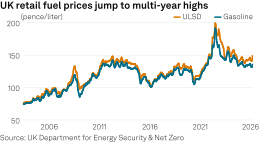
The emergency measures follow growing concern over the potential influence of the war in the Middle East on the cost of living in the UK, which relies heavily on imported fuel. By March 9, rising international oil prices had already pushed diesel prices in British fuel stations to their highest since 2024, according to government data.
Before the war erupted, the UK Treasury planned to phase out fuel duty cuts put in place in 2022 to combat rising prices after Russia's invasion of Ukraine. In the next year, 5 pence cuts to diesel and gasoline duties were due to be unwound in three phases, starting in September. The Spring Statement on March 3 projected the tax hike would raise GBP24 billion in government revenue in fiscal year 2025-26.
Starmer told reporters the government had extended the cut until September, without providing further details on future plans.
Additionally, the government announced GBP50 billion in targeted financial support for UK heating oil consumers, who are concentrated in Northern Ireland and rural areas. Starmer repeated his criticism of heating oil suppliers exploiting the current market situation by "jacking up prices" and warned of legal repercussions after an investigation by the UK competition authority.
The relief measures from Starmer come as governments around the world grapple with sweeping economic risks linked to the war in the Middle East, which has pushed Dated Brent crude prices above $100/barrel for the first time in four years. "We don't know what might happen in three months or six months," Starmer said, responding to questions about future options to protect fuel affordability.
The UK is participating in an unprecedented 400 million barrel stock release coordinated by the International Energy Agency and will contribute 13.5 million barrels of oil from its national inventories. In addition to a stock release, IEA member countries can also enact other emergency protocols, including fuel rationing, surge production or relaxing fuel quality standards, although most governments have yet to announce plans for such measures.
Starmer did not address comments made on March 16 by energy commentator Nick Butler -- a former BP executive and adviser to former Prime Minister Gordon Brown -- that the UK could be forced to ration fuel if the crisis continues.
Oil and gas 'rollercoaster'
Beyond the UK's borders, Starmer said the critical Strait of Hormuz should be reopened amid Iranian attacks on tankers to "ensure stability in the markets." Before the war, the waterway handled some 20 million barrels/day of crude and products.
US President Donald Trump has demanded that several countries, including the UK, step in to help the US reopen the critical waterway.
Starmer said doing so was "not a simple task," adding that the UK was working with allies in Europe, the Gulf and the US to create a "viable plan" to ensure navigation. Addressing the war itself, Starmer said de-escalation was the best way to ease the impact on UK households.
Upstream, building on recent comments from Energy Secretary Ed Miliband, Starmer told journalists that only a pivot to renewables would free the UK from the "rollercoaster" of global oil and gas prices.
"If you are on the international market for oil and gas, you are vulnerable," the prime minister said. "What gives us control is renewables, our own homegrown energy, which is more secure and independent, which is why I think we should go further and faster in renewables."
Asked about the North Sea, where production has been dwindling in recent years but which still supplies a third of UK gas demand, Starmer said hydrocarbons would "be part of the mix for many years to come."
However, he cautioned that UK output cannot ease global price shocks, rejecting recent demands from industry and unions to approve fossil fuel projects and open up the basin to new exploration.
"We did make progress on what is called tiebacks," Starmer said, referring to a new Treasury plan that "allows further access into oil and gas in the North Sea" by permitting infrastructure-led drilling to offset declines at existing fields.
However, he said the contentious Energy Profits Levy is important during times of crisis. "There is a windfall tax in place, we continued and extended that, you can see in a situation like this why it is so important to do so," Starmer said.
The EPL, which is due to expire in or before 2030, has driven the North Sea tax rate to 78% and has been blamed for a wave of exits and consolidations in the basin and falling production.
The UK pumped 632,000 b/d of crude and NGLs in November, a 60% drop from 2009 levels, according to government data. Gas output has halved since 2008 to 31 billion cubic meters in 2024.
Editor:

Editor: