Crude Oil, Maritime & Shipping
March 05, 2026
India weighs alternate crudes, refining costs, economic fallout as Iran conflict drags on
HIGHLIGHTS
India seeks alternate crude from US, Russia
Refiners face higher costs, freight charges
Strait of Hormuz disruption threatens 50% of imports
Indian refiners are maintaining their normal throughput levels but have started negotiating for incremental crude oil cargoes from the US, Russia, and West Africa to ensure that supplies remain plentiful in the event the Middle Eastern conflict drags on for a longer period, industry officials and analysts said March 5.
While physical crude availability in the country might be sustained through alternative sourcing, analysts and refining sources said there were concerns that the cost structure would deteriorate sharply due to higher crude procurement prices, elevated freight and insurance costs, as well as longer shipping routes.
"India faces elevated exposure to this disruption, with an estimated 50%-55% of its crude oil and LNG imports transiting the Strait of Hormuz. Strategic petroleum reserves cover only 8-9 days of oil demand, and there are no comparable strategic reserves for natural gas. If the disruption persists beyond the very short term, supply-side stress will intensify rapidly," said Sumit Pokharna, vice president at Kotak Securities.
India's Strategic Petroleum Reserves currently have about 9.5 days of net oil imports. In addition, state-run oil companies hold storage facilities for crude oil and petroleum products equivalent to 64.5 days of total net imports, bringing the current total national storage capacity for crude and petroleum products to 74 days of total net imports, according to petroleum ministry data.
Indian refineries processed 5.63 million b/d of crude in January, up slightly from 5.62 million b/d a year earlier, the oil ministry's latest provisional update showed Feb. 24. The crude processed in January was 9.1% higher than the month's target of 5.16 million b/d and was 0.2% higher than the processing level in December, the oil ministry said. Data for February has still not been released.
"There is no need to cut throughput yet. Domestic crude stocks with refiners are sufficient for now. But refiners have started talking to alternative sources to bring in displaced volumes if there is a need," Shrikant Madhav Vaidya, former chairman of state-run Indian Oil Corp., told Platts, part of S&P Global Energy.
Product exports, Russian volumes
Industry officials added that Indian refiners could limit oil product exports and divert some of the volumes to the local market if the Middle East conflict continues for a longer period.
Around 52% of India's roughly 5 million b/d of crude imports pass through the Strait of Hormuz, with Iraq, Saudi Arabia, the UAE, Kuwait, and Qatar as its key Middle Eastern suppliers, according to data from S&P Global Commodities at Sea. India's exposure to Hormuz flows was lower at 41% in 2025 but has increased in recent months as Indian refiners have reduced their Russian crude purchases, averaging around 1.15 million b/d in the first two months of 2026, compared with 1.7 million b/d in 2025.
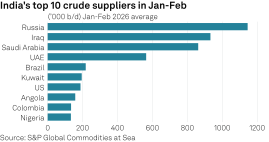
"It will not be surprising to see Russian volumes rising again temporarily. It will be easier for Indian refiners to bring in those cargoes for immediate replacement rather than bring them all the way from the US or West Africa," an India-based refining source said.
Indian sources said that refiners have sealed deals for a few Urals cargoes for prompt delivery, as many of them were floating cargoes.
"It will be a bonanza for Russian volumes if the fight prolongs. The Hormuz choke would mean 10 million-12 million b/d off, assuming some leading Middle East producers can divert about 40% of volumes through Aden. India will buy Russian oil, wherever there is an offer, including the Urals currently stranded. They may intimate the US and use the argument of force majeure, as well as highlight the need for energy security," said B. Anand, industry expert and former CEO of Nayara Energy.
On Middle Eastern crudes, India will be the natural beneficiary of shipments from the Yanbu port, but it remains to be seen how much incremental capacity the port can handle, Anand added.
Economic, price impact
Crude oil futures rose during midmorning Asian trading on March 5. At 11:44 am, Singapore time (0344 GMT), the ICE May Brent futures contract was up $2.22/b (2.73%) from the previous close at $83.62/b, while the NYMEX April light sweet crude contract was up $2.41/b (3.23%) from the previous close at $77.07/b.
CAS data showed a complete halt of large oil tankers in the main Traffic Separation Scheme transit channels as of midday March 4, Platts reported earlier. Around 12 tankers were transiting daily before hostilities began on Feb. 28.
Equity research firm Jefferies said in a research note that for India, the crude oil price spike post-Hormuz closure and the time taken to return to normal would be important. If crude stays above $80/b, the retail price adjustment and/or a cut in fuel excise duties may happen. Every $10/b jump can have a 20-25 basis points impact on the Consumer Price Index if the oil price jump is passed on to the consumer or on the fiscal deficit if the government cuts taxes.
"The initial impact will come through a jump in the import bill, a widening current account deficit, and a weaker rupee. But the bigger risk is of this morphing from an affordability problem to an availability crisis. India could potentially be staring at an energy shortage and demand rationing scenario if the Hormuz blockade drags on, with crude and product reserves sufficient for only six weeks or so," said Priyanka Kishore, director and principal economist at Asia Decoded, a Singapore-based research consultancy.
