Crude Oil, Refined Products, Maritime & Shipping, Fuel Oil, Jet Fuel
March 05, 2026
FACTBOX: Fresh attacks hit shipping, energy operations in the Middle East
Getting your Trinity Audio player ready...
HIGHLIGHTS
Tanker hit offshore Iraq
Crude prices rise
Refineries reducing runs
Oil producers and exporters in the Middle East continue to face severe restrictions on shipping through the Strait of Hormuz and ongoing attacks on energy infrastructure.
"The scale and duration of a price spike will depend on how much oil is kept off the market — and for how long — due to danger in the strait, higher shipping insurance rates or damaged Gulf infrastructure," analysts at S&P Global Energy CERA said in a note March 5.
Below are key facts being watched by the Platts news team:
Trade flows
- Iranian officials continue to warn ships not to use the Strait of Hormuz without authorization.
- Concerns are rising that producers will have to shut in production due to limited storage options.
- Signals from S&P Global's Market Intelligence Network showed no tankers crossed the Strait of Hormuz on March 5.
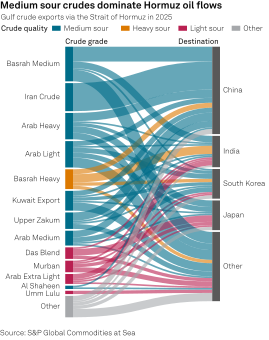
- Some 15 million barrels/day of crude and 5 million b/d of oil products passed through the Strait of Hormuz in 2025, according to CAS data.
- Vessels are beginning to reroute toward Yanbu on Saudi Arabia's west coast to support continued production. Just over 2.356 million b/d of crude have been loaded so far in March at Yanbu, compared with monthly averages between 650,000-1 million b/d over the preceding six months, according to CAS data.
- Crude exports from southern Iraq appear to have dried up after production cuts at the 1.2 million b/d Rumaila field.
Prices
- Energy prices across commodities continued to respond to the attacks, as supply disruption grips the markets.
- Platts, part of S&P Global Energy, assessed Dated Brent at $81.155/b on March 4, up 14% from Feb. 27- the day before the US and Israel attacked Iran.
- Platts assessed cash differentials for key Middle East sour crude markers at all-time highs during the Singapore Platts Market on Close assessment process on March 5. May cash Dubai and cash Oman were both assessed at a premium of $19.47/b to same-month Dubai futures at the market close, up $6.42/b day over day.
- Platts assessed Platts AGS, reflecting WTI Midland grade transported to the Gulf Coast from the Permian Basin, at $76.32/b March 4, up 12% from Feb. 27.
- The Platts VLCC index for non-scrubber-fitted, non-eco vessels soared 93% day over day March 4 to $517,966, up 150% from the Feb. 27 level.
- Platts assessed jet fuel barges on a FOB basis at Flushing-Amsterdam-Rotterdam-Antwerp-Ghent at $1,259/metric ton March 4, up 52% from Feb.27.
- Platts assessed ultra-low sulfur diesel barges on a FOB basis at Amsterdam-Rotterdam-Antwerp at $987.75/mt March 4, up 31% from Feb. 27.
- Bunker prices have risen across key hubs. Platts assessed delivered 0.5% sulfur fuel oil at Fujairah at $670/mt March 4, up 35% from Feb. 27.
Infrastructure
- Critical energy facilities across the Gulf have come under direct attack, disrupting operations and threatening supply chains.
- In Iraq the Basra refinery was temporarily shut after the country was hit by a nationwide blackout late March 4.
- This follows reduced production at Iraq's Rumaila field as storage filled up.
- Earlier in the week, oil storage and bunkering activities at the UAE's Fujairah port were suspended due to a fire caused by debris from an intercepted drone.
- In Saudi Arabia, the Ras Tanura oil refinery has been targeted and the US has warned of potential attacks on Dhahran, where Saudi Aramco -- the world's largest oil company -- has its headquarters.
- Consumer nations have begun to respond to the supply risk, with the International Energy Agency calling an extraordinary meeting and Indonesia announcing plans to build 90-day oil storage facilities to boost energy security.