Crude Oil, Refined Products, LPG
March 03, 2026
India assures uninterrupted oil product supply; crude diversification offers cushion
HIGHLIGHTS
Energy companies can access alternative supply sources
About 52% of India's crude imports transit Strait of Hormuz
LPG diversification shifts toward the US and Canada
India has sufficient stocks of crude oil and petroleum products to address potential short-term disruptions resulting from the Middle East conflict, and the country's energy companies can access supplies that do not pass through the Strait of Hormuz, a government statement said March 3.
"India has ensured both availability and affordability of energy for its population by diversifying its sources," the statement from the Ministry of Petroleum and Natural Gas said. "Indian energy companies now have access to energy supplies that are not routed through the Strait of Hormuz. Such cargoes will remain available and help mitigate supplies that may be temporarily affected en route through the Strait of Hormuz."
A separate petroleum ministry statement from March 2 said India would ensure uninterrupted domestic supplies of petroleum products and take all necessary measures to keep these products affordable for end-users. The government also said it was in discussions with all state-owned refiners to develop a domestic supply strategy.
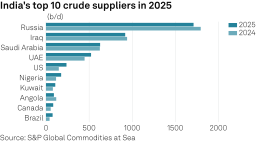
Around 52% of India's roughly 5 million barrels/day of crude imports pass through the Strait of Hormuz, with Iraq, Saudi Arabia, the UAE, Kuwait and Qatar as its key Middle Eastern suppliers, based on data from S&P Global Commodities at Sea. India's exposure to Hormuz flows was lower at 41% in 2025 but has increased in recent months as Indian refiners have reduced their Russian crude purchases, averaging around 1.15 million b/d in the first two months of 2026, compared with 1.7 million b/d in 2025.
"It is an extremely constraining situation for India to get crude supplies. Alternative routes have limitations of capacity, such as the Gulf of Oman. In the event of a prolonged conflict, India will need to maximize supplies from longer routes, like the US, West Africa and Venezuela, and even from Russia if they can work out a plan," said DLN Sastri, former director of refining at the Federation of Indian Petroleum Industry.
LPG diversification
"India's LPG diversification plan will also help under current circumstances," said one senior oil industry source in India.
According to S&P Global Energy CERA, India is increasingly turning to US and Canadian LPG as geopolitical tensions reshape global trade flows. With US–China frictions redirecting American barrels and India seeking to reduce its dependence on traditional Middle Eastern suppliers, North American LPG is gaining a stronger foothold in India's import mix.
Recent trade patterns show rising US volumes moving into India, supported by competitive pricing and expanding export capacity. Canada is also emerging as a complementary supplier as Asian buyers diversify. Together, these shifts highlight a broader realignment in LPG flows, with India well‑positioned to leverage North America's growing role in global supply, it added.
India imported 2.297 million metric tons of LPG in January -- comprising 1.244 million mt of propane and 1.053 million mt of butane -- down 2.09% month over month but up 24.51% year over year, CAS data showed.
The country took delivery of 287,000 mt of LPG from the US in January, up 122.48% month over month, CAS data showed. India sourced 2.006 million mt of LPG from the Middle East in January -- including the UAE, Qatar, Kuwait, Saudi Arabia, Oman, Bahrain and Iraq -- accounting for 87.33% of its total imports for the month, according to CAS data.
Domestic production
Industry leaders highlighted that India's significant reliance on energy imports makes it vulnerable to geopolitical shocks in resource-rich areas, such as the ongoing conflict with Iran. As a result, there was an urgent need to boost domestic production.
"Oil and gas are the biggest items in our import bill, around $176 billion/year, and any sharp rise in prices has an adverse effect on macroeconomic indicators like current account deficit, value of the rupee, fiscal deficit and inflation. India cannot wait," Anil Agarwal, chairman of Vedanta group, said in a statement March 3. "The world is more unsettled and uncertain than it has been at any time in my memory. There are no permanent friends or partners in today's geopolitics. Self-reliance is more than a desirable aspiration."
Cairn Oil and Gas, part of Vedanta, recently said it was looking to boost production from its mature fields in Rajasthan using advanced recovery methods, while expanding offshore exploration along both the eastern and western coasts of India.
Cairn has set aside $4 billion for capital investments across various assets, while increasingly using AI-driven reservoir modeling, real-time production optimization, digital subsurface workflows and low-cost drilling innovations to shorten cycle times and enhance capital efficiency, Platts reported earlier.
According to S&P Global Energy CERA, the Rajasthan assets are Cairn's main cash cow, positioning it to remain highly liquids-weighted amid the general E&P industry's shift toward gas-weighted assets.
