Maritime & Shipping, Wet Freight
February 28, 2026
Iran claims Hormuz closure as oil tanker traffic drops sharply
By Staff and Aresu Eqbali
HIGHLIGHTS
IRGC warns all ships from Strait of Hormuz
Vessels heading toward the exit of Hormuz
Ships told to avoid the waters
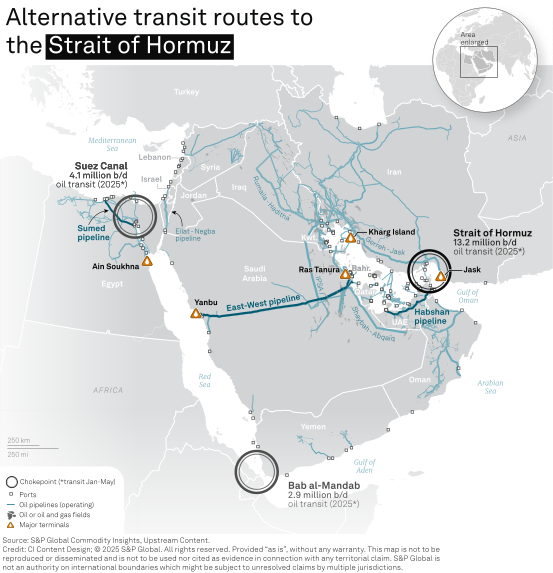
Oil shipping traffic through the Strait of Hormuz declined on Feb. 28 after Iran claimed to have shut Hormuz in response to US and Israeli missile strikes.
Iran's state media said Feb. 28 that the Islamic Republic has shut the critical Strait of Hormuz after a day of missile strikes rocked the oil-rich Gulf region.
Roughly one-fifth of the world's daily oil trade passes through the narrow Strait of Hormuz, just off the coast of Iran.
The "Strait of Hormuz is shut down," the semi-official Tasnim news agency said following a day of missile exchanges between Iran and a coalition of Israel and the US.
"By 1930 UTC, the Strait of Hormuz area showed an approximately 40% to 50% drop compared with earlier in the day, with vessels funneling toward the exit, suggesting that ships are racing to exit the area," S&P Global Commodities at Sea analysts said in a report on Feb. 28.
According to S&P Global MINT data, very few crude tankers were in the Strait of Hormuz late Feb. 28. The Desh Abhimaan was on its way to Ras Tanura and turned around before entering Hormuz on Feb. 28. The New Vision and the Valor, both laden with crude and bound for Fujairah, were nearing the Strait of Hormuz late Feb. 28.
"Outbound flows of crude and refined products (including LPG) loaded in February and transiting the Strait averaged 20.4 million b/d month to date, down from 21.2 million b/d in January," the CAS analysts said.
"Hormuz risk is not only about closure but also fleet productivity. If Iran escalates by seizing tankers or using drones to threaten commercial traffic, voyage times and possibly costs for Middle East oil exports would further increase," S&P Global CERA analysts said on Feb. 28.
Container ship company Hapag-Lloyd said on Feb. 28 it had suspended movements through the Strait "until further notice."
Services "calling ports in the Arabian Gulf may experience delays, rerouting, or schedule adjustments. We are working to minimize disruption and will communicate any material changes to affected shipments as soon as possible," the company said on its website.
Ships have received repeated messages in high frequency from the Islamic Revolutionary Guards Corps (IRGC) warning that no ships are allowed to pass through the Strait of Hormuz, said Tasnim on Feb. 28, which is controlled by the IRGC.
The messages received by mariners cannot be independently verified, the United Kingdom Maritime Trade Operations said.
"Mariners are advised that VHF broadcasts or statements indicating closure of the Strait of Hormuz are not legally binding and do not constitute a lawful restriction on navigation under international law, including the United Nations Convention on the Law of the Sea (UNCLOS), unless implemented and enforced in accordance with applicable legal frameworks," the UKMTO statement said.
Maritime risk firm Ambrey issued a notice Feb. 28 that advised ships, especially those with links to the US and Israel, "to shelter in territorial seas and avoid transits through the Persian/Arabian Gulf, Strait of Hormuz, southern Red Sea, and Gulf of Aden."

Editor: