Refined Products, Crude Oil
February 19, 2026
FEATURE: Energy majors tout oil growth plans with eye on capital discipline

HIGHLIGHTS
Projects in Brazil, US Gulf, Africa to drive output
Firms double down on oil, gas despite weak prices
Focus on cost-cutting, get boost from refining margins
Energy majors highlighted significant oil and gas expansions in Brazil, the US Gulf and West Africa and a renewed focus on capital discipline in their recent earnings updates, while recommitting to shareholder returns over renewables expansion.
In the past year, the world's largest energy companies have been trimming spending on low-carbon and power projects, chief among them BP, which is over halfway through a $20 billion disposal program and a full strategic shift.
In their Q4 and full-year 2025 financial results, BP, Shell and TotalEnergies doubled down on traditional hydrocarbons, laying out plans to cut costs and clean energy investments and hunt for the billions of barrels of oil required to meet future demand.
But they also warned that a bearish market outlook would require strict capital discipline and outlined efforts to build upstream resilience to lower prices. The Platts-assessed Dated Brent benchmark lost around $11/b in 2025, one of its steepest annual drops, with analysts from S&P Global Energy predicting further softening in 2026.
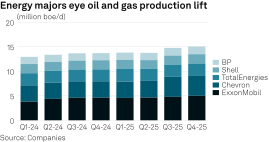
The three European majors all reported strong upstream output in Q4, with a combined 6 million boe/d of oil and gas, compared to 5.74 million boe/d in the fourth quarter of 2024.
US majors Chevron and ExxonMobil, which have outperformed their European rivals in recent years, also saw increased production, particularly from the Permian Basin, where cutting-edge technology is improving recovery rates.
ExxonMobil's oil and gas output hit a four-decade high of 4.7 million boe/d in 2025, while Chevron added some 400,000 boe/d to its US output over the year, driving total production to 4.05 million boe/d in Q4.
Growth focus
All five companies charted a path to significant production growth in the coming years, through new exploration, development of existing discoveries, management of late-life assets, and M&A.
The three European majors are looking at major projects in Brazil, Namibia, the US Gulf of Mexico and West Africa to anchor significant hikes through 2030, with Shell alone targeting an additional 1 million boe/d.
BP, which says it went "too far, too fast" on renewables under previous CEO Bernard Looney, brought seven new projects online in 2025, with three more expected by 2027, and has been buoyed by its Bumerangue oil discovery off Brazil, which at 8 billion barrels of liquids is its largest in 25 years.
IOCs are also expecting additional volumes to come from Namibia's Orange Basin from 2030, through TotalEnergies' huge Venus and Mopane finds and Capricornus/Sagittarius, in which BP has a stake through its JV with Eni.
TotalEnergies should also start production at its 190,000 b/d Tilenga project onshore Uganda this year, following significant delays.
On the US side, Chevron is forecasting 7%-10% production growth in 2026 alone, powered by projects in Guyana, the Mediterranean and the US Gulf of Mexico, and a further 2%-3% annually through 2030.
ExxonMobil is planning to reach 5.5 million boe/d of oil and gas by 2030, including by hiking production from its key Stabroek block off Guyana from 900,000 b/d currently to 1.7 million b/d.
Both US majors are also exploring new opportunities in Venezuela following the capture of Nicolas Maduro in January, they said in their results.
Other areas of interest include West African and Caribbean frontiers, established producers Libya and Kuwait, and the Caspian, with majors confident of rising oil demand.
"We don't see any peak demand coming in front of us at this stage," TotalEnergies CEO Patrick Pouyanne said on an analyst call, predicting global demand growth of "a little less than 1 million b/d" in 2026.
"Simply put, there is no near-term peak Permian for us," Darren Woods, ExxonMobil's CEO, told an earnings call.
Oil analysts at S&P Global Energy CERA predict total oil liquids demand will be about 106 million b/d in 2040.
Cost cutting
A focus on production growth comes at a moment of intense cost cutting. But even with weak crude prices denting profits, most of the trimming has come from low-carbon and chemicals budgets.
BP recorded $4.2 billion in impairments in Q4, mostly in its transition and biogas business, and became the first major to end its share buyback spree.
Meanwhile, Shell CEO Wael Sawan promised to "leave no stone unturned" in scrutinizing costs and fixing the company's unprofitable chemicals business. Sawan promised to build on $5 billion of cost cutting since 2022, despite keeping its 2026 capex budget in line with 2025 levels.
TotalEnergies, which produces more oil and gas than its two European rivals, still has a large renewables footprint, and in November agreed to purchase 50% of Czech energy group EPH's power generation assets for $5.9 billion.
But the French major plans to shave $500 million off its low-carbon energy investments in 2026 to $3 billion, just 20% of its total investments.
Refining buffer
For the European majors, stronger refining margins proved a balm for weaker earnings in Q4.
Shell's indicative refining margin reached $13.8/b in the quarter, more than double the previous year's level, with refinery utilization averaging 95%, the company said.
BP's refining margins also roughly doubled year over year to $15.20/b, though they were down slightly on the previous quarter due to higher turnaround activity and a temporary outage at the Whiting refinery.
"You've seen in the fourth quarter results that Refining & Chemicals have really been able to capture the very good margin, $11/b," Pouyanne said.

Editor: