Crude Oil
February 12, 2026
IEA sees narrower oil surplus after January production slump

HIGHLIGHTS
Global oil supply fell by 1.2 million b/d in January
Full-year production growth outlook cut by 100,000 b/d
Peak oil surplus now seen coming in Q2 2026
The International Energy Agency has revised down the magnitude of the global oil supply glut it foresees in the first quarter of 2026 after weather-related outages and sanctions pressure slashed output in January, it said Feb. 12.
In the latest edition of its closely-watched monthly oil market report, the IEA said that the world's oil producers pumped 1.2 million barrels per day less supply in January, observing what it called an "exceptional plunge" that should recover in the coming months.
The surprise contraction was driven by extreme winter weather that shut in over 1 million b/d of North American production, coupled with prolonged disruptions at Kazakhstan's key CPC export terminal, the IEA said.
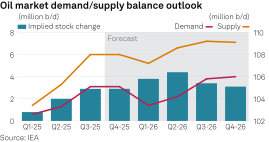
The agency's revised forecast puts world oil supply on track to rise 2.4 million b/d annually in 2026, 100,000 b/d less than its January outlook and lagging 2025 growth by 700,000 b/d. In contrast, demand is only expected to increase by 850,000 b/d, causing output to overshoot expected demand by nearly 4 million b/d.
The latest forecast from the Paris-based IEA, which advises its membership of OECD countries on energy policy, maintains a consistent message of an impending "superglut" expected by many oil market observers, but nudges back the timeline for when the imbalance will reach its height.
In last month's forecast, the IEA projected that world oil supply would overshoot demand by a peak of 4.6 million b/d in Q1 2026, before gradually easing through the rest of the year. It now expects the quarterly surplus to average 3.8 million b/d, rising to 4.4 million b/d in Q2.
The view exceeds a peak surplus of 2.6 million b/d in Q1 expected by analysts at S&P Global Energy CERA, who see more robust demand growth of 1.1 million b/d in 2026.
Supply rebound
For the most part, the factors impacting January output are likely to be short-lived, according to the IEA.
As weather-related shut-ins recede, steady supply injections are expected to be driven primarily by the Americas Quintet -- the US, Canada, Brazil, Guyana and Argentina -- which collectively are set to add 1.8 million b/d to their output this year.
In Venezuela, US tanker blockades and geopolitical turmoil after the removal of its former president, Nicolas Maduro, cut monthly production by 210,000 b/d to 780,000 b/d in January, the IEA said. However, levels have shown signs of recovery amid recent efforts by Washington to lift export restrictions and encourage a revival of the sector, it said.
Widespread political unrest in Iran did not disrupt its oil production, which remained roughly stable at 3.45 million b/d on the month, although exports took a hit of 180,000 b/d, the IEA said.
Stricter US and EU sanctions seemingly took a toll on Russian crude supplies, which fell by 350,000 b/d in January as established buyers appeared to shun discounted Urals supply.
According to the IEA, India imported 1.1 million b/d of Russian oil in January, its lowest volume since November 2022 and down from a 1.7 million b/d average in 2025. In contrast, shipments to China surged to an all-time high, providing an export route that could become increasingly important to prop up Russian flows.
"China remains the main candidate to absorb additional Russian supply with its 19.9 million b/d refining capacity," the IEA said, estimating that roughly 17% of its crude imports are currently supplied by Russia.
Eyes on China
On the demand side, higher oil prices and economic uncertainty have dimmed consumption prospects, while lasting growth hinges largely on China, the IEA said.
With global oil growth concentrated among price-sensitive non-OECD countries, higher-than-expected prices are expected to temper demand, the IEA said, cutting its 2026 growth outlook by 80,000 b/d from a previous 930,000 b/d.
China is expected to be the world's single largest driver of rising oil consumption, despite its rapid electrification leaving demand for the three major fuels -- gasoil, gasoline and jet fuel -- roughly flat year-on-year.
According to the IEA, China is set to consume roughly 200,000 b/d more oil in 2026, driven almost exclusively by a booming petrochemicals sector supporting demand for naphtha, ethane and LPG.
At the same time, Chinese stockpiling has made the country a significant shock absorber in an oversupplied market shaped by record volumes of sanctioned oil at sea.
Encouraged by new government import quotas, Chinese refiners hiked their imports and storage injections in January, the IEA said, estimating a total stockbuild of 42.5 million barrels on the month. According to a February report from energy intelligence company Kayrros, China led a 78 million barrel build in global storage capacity, upgrading its capacity to continue stockpiling.
Elsewhere, stockpiling appetite remains a point of uncertainty, as refinery runs have normalized from all-time highs in December. "It remains to be seen when surplus barrels finally move ashore in the Atlantic Basin," the IEA said, estimating global observed oil inventories at their highest since 2021.

Editor: