Agriculture, Energy Transition, Electric Power, Biofuel, Renewables
February 10, 2026
Mexico accelerates private power partnerships; industry upbeat but wary on contracts

By Sheky Espejo
HIGHLIGHTS
Mexico plans 6.5 GW clean power projects by 2029
Industry upbeat on private partnerships, opportunities
The Mexican government is moving to accelerate private-sector participation, laying out details and conditions for partnerships to build 6.5 GW of clean electricity generation capacity by 2029, sparking optimism in the industry, but also plenty of questions.
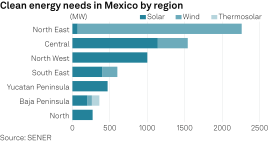
The country needs 3.5 GW of new solar power capacity and 2.85 GW of wind power, according to a presentation given to potential players and stakeholders on Feb. 6. The presentation was given by top officials from the state utility, CFE, and the energy ministry to over 300 attendees, according to people who were present.
The government is asking interested parties to register to participate by Feb. 20, according to the presentation, seen by Platts, part of S&P Global Energy.
Authorities, including the national center for energy control, CFE and a specialized group formed solely for these projects, will analyze the profiles based on their financial capabilities by March 13, and then companies will be asked to present their proposals, according to the presentation. Projects will be focused on seven regions of the country, with the main focus on the North East and Central regions, where the government says 3.8 GW of new capacity is needed.
The government will begin making final decisions in April, choosing winners and signing contracts by April 26, aiming to begin construction in November so that projects can begin commercial operation by 2029 at the latest, according to the presentation.
Market participants and industry observers are feeling optimistic about the opportunities ahead, broadly welcoming the government's renewed openness to private investment.
"Everything we are hearing is positive," said Alejandro Robles, executive director of project developer MRS in Mexico City, who attended the event. "6.5 GW is a lot, and CFE is making it easy for builders by assuring the purchase of at least 70% of the energy produced," Robles said, noting that CFE will use it for both retail and industrial customers.
The government is also showing greater flexibility, Robles said, as it is allowing companies to propose projects for large areas of the country rather than tying them to specific regions or even nodes.
In November, the government invited private participants to develop roughly 6 GW of new capacity in about 25 "strategic" locations, which were very specific. The invitation attracted interest for only half of that capacity.
"It seems that this time the authorities are incorporating all the lessons learnt," Robles said.
Wary on contract details
Despite the broad optimism, some still have doubts.
The timing seems tight, and is likely to interest only brownfield projects with a lot of work already done, said Arturo Carranza, head of energy projects at consultancy AKZA, who attended the event and advises clients in the industry.
"The conditions are not easy, and it will take a lot of analysis," Carranza said.
Under the structure outlined, private partners will contribute all the capital required to develop the projects, while CFE will retain at least a 54% stake.
Others cautioned that the success of the schemes will hinge on the fine print of the contractual models.
"Key issues remain to be clarified, including bankability, corporate governance provisions in project bylaws, termination clauses, payment structures and guarantees, asset reversion mechanisms and financing risks borne by the private partner," said Claudio Rodríguez Galán, head for Latin American practice at law firm DWF.
"These concerns over dispute resolution and enforcement come particularly in light of recent changes to Mexico's judicial framework," he told Platts.
While acknowledging the government's stated commitment to legal certainty, participants question whether contractual assurances alone would be sufficient to mitigate the risk of disputes between private investors and the Mexican state.
Confidence will ultimately depend on whether the contractual structures provide lenders and investors with enforceable protections consistent with international project-finance standards, observers say.

Editor: