Chemicals, Olefins, Polymers
May 22, 2026
US ethylene exports remain elevated as Middle East war tightens European supply

Editor:
HIGHLIGHTS
US share of global exports surges
European cracker outages drive demand
A significant uptick in European demand since the war in the Middle East broke out has kept US ethylene exports elevated, according to the latest full-month S&P Global Commodities at Sea data.
US ethylene exports have been going steadily to Europe since 2025, but shipments jumped significantly after the start of the Middle East conflict.
Total US ethylene exports rose from 60,000 metric tons in February to 155,000 mt in March, with most of the volume going to Europe, according to CAS data. The main recipients were Belgium, Italy, the Netherlands and Portugal. During this time, the US' share of global ethylene exports also increased from42% to 89.8%.
These levels remained elevated throughout April, totaling 124,000 mt out of the US.
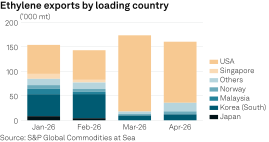
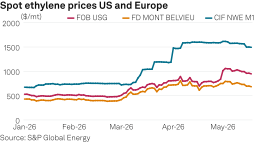
This surge in volume came as cracker outages in Europe kept ethylene supply tight, driving spot prices higher and boosting demand for imports.
In the US, this was reflected in higher terminal fees for spot cargoes, reaching 20-25 cents/pound in mid-April, up from a previously fixed 4-6 cents/lb.
"Europe couldn't really take the risk for late delivery, so that is why the 20-cent/lb cargo got done," an olefins trader said.
While the fees on spot cargo exports have since come down from their peaks, they remained elevated at about 12 cents/pound, according to the latest market feedback, widening the spread between domestic and export ethylene prices while still maintaining an open arbitrage to Europe.
Additionally, Tyler Cott, senior vice president of hydrocarbon marketing, said spot loading rates on the US Gulf Coast had risen following the surge in demand, reaching as high as 55 cents for various products, including ethylene, propylene, LPG and ethane.
"Yes. We've seen elevated spot rates. They've been volatile," Cott said. "They've been as high as kind of what you mentioned, and they're off from those highs now. Our system has more flexibility than it did previously. And so we'll respond to what products the markets need and have the highest value with the spot capacity that we have available."
Domestically, ethylene's margins to upstream and downstream markets have widened since the beginning of the war, with significant price increases in the polyethylene export market and ethane's prices remaining low despite the uptick in export demand.
"There is a lot of good reason for [the] market to become tighter [higher exports and summer season demand for natural gas and ethane], but there is a lot of room for buffer for spread ethane," a second olefins trader said.
These wide margins have created a disconnect in immediate market dynamics throughout the chain, with ethylene market participants saying prices have been balancing mainly to European arbitrage conditions.
However, following announcements that crackers are coming back online in Europe earlier than anticipated, demand for US imports might be impacted.
"We are already seeing less interest in US ethylene into Europe," a shipbroker said.
Platts, part of S&P Global Energy, last assessed spot ethylene at 30.50 cents/lb Mont Belvieu pipeline and at 42.50 cents/lb FOB USGC on May 21, both down 0.50 cent day over day.
Market participants remained in a wait-and-see mode, with their attention fixed on the possibility of a US-Iran agreement. However, confidence remained that market conditions would remain balanced.
