Agriculture, Meat
April 30, 2026
Brazilian live pig prices fall 16% MOM amid rise in pork exports to Asia
By Nuo geng Chen and Ignacio Garcia
Editor:
HIGHLIGHTS
Weak domestic demand weighs on live pig prices
Japan, Malaysia boost Brazilian pork imports
Asia exports surge as trade patterns shift
Live pig prices in Brazil's five main producing states fell 16% month over month to $1.05/kg, as weak domestic demand and rising exports to Asia reshape the market, according to Brazil's Center for Advanced Studies on Applied Economics April 28.
Brazil's domestic demand remains weak, as consumers shift from pork to chicken, a Japan-based buyer said. Brazilian meatpackers are offering larger volumes to Japan, signaling ample supply.
Japanese imports of Brazilian pork rose 85% year over year and 50% month over month in March, Comex Stat data showed. The increase reflects Japan's search for alternatives amid declining Spanish inventories.
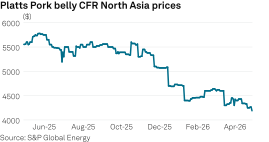
Pork belly CFR North Asia prices have trended lower over the past year. Platts, part of S&P Global Energy, assessed pork belly at $4,190/metric ton April 29, down $75/mt from the previous day, $435/mt from last month, and $1,364/mt from a year ago.
Brazil's export landscape is shifting, as the Philippines—traditionally the largest importer—bids at low prices due to domestic oversupply and warehouse constraints, a Brazil-based trader said.
Japan and Malaysia have become the strongest buyers of Brazilian pork, with Japan showing robust demand, a Brazil-based trader said.
US pork traders are closely monitoring the rising supply of Brazilian pork in Asian markets, weighing its potential impact on domestic prices.
Conflict in Iran has disrupted vessel traffic through the Strait of Hormuz, forcing carriers to reroute or delay shipments. The effective closure has increased shipping costs, transit times, and uncertainty for American exporters to Asia.
Uncertainty has led some traders to make anticipatory moves, affecting their financial results.
A US trader told Platts that the war was expected to disrupt Brazilian pork exports to the Middle East, leading to an oversupply in North America, especially in Mexico. "Brazilians have found other routes and are now shipping 200 containers of pork daily to the Middle East," the trader said. "The US market has not been affected, and prices continue to rise, which is typical for this time of year."
Brazil is Mexico's third-largest pork supplier, after the US and Canada, according to the Mexican Meat Council. In 2025, Mexico imported 14,000 mt of Brazilian pork. In the first three months of 2026, Mexico imported 8,300 mt of Brazilian pork, up 36.1% year over year, the largest increase among suppliers. The US and Canada also increased shipments by 2.1% and 16.5%, respectively.
Market participants continue to monitor supply shifts and geopolitical risks, while trade flows and pricing remain volatile. The ongoing conflict and shifting demand patterns may further affect global pork markets in the coming months.
